Finding a hair salon in Tokyo that works for American clients — one that speaks English, understands your hair type, and produces a result you’d actually be happy with — is harder than it sounds. Most Americans figure this out the hard way after one or two disappointing appointments. This guide skips that part.
The Reality of Tokyo Salons for Americans
Tokyo has thousands of hair salons and some of the most technically skilled hairstylists in the world. The issue for Americans isn’t quality — it’s fit. Japanese salons are designed, staffed, and stocked for Japanese clients with Japanese hair. American hair — which spans fine wavy, thick curly, highlighted, bleached, color-treated, and everything else — requires a different technical approach that most Japanese stylists haven’t trained for.
The language barrier is the obvious challenge. The less obvious one: even when English communication works perfectly, a stylist who’s only ever worked on straight Japanese hair may produce the wrong result on your hair — not because they’re careless, but because they genuinely lack experience with what your hair needs.
What Americans Should Know Before Their First Tokyo Appointment
- Bring photos — not descriptions. “I want a trim” and “just clean it up a bit” don’t translate across cultural contexts. A photo of what you want (and one of what you don’t want) communicates instantly. Japanese salons work with visual references far more effectively than verbal ones.
- Use centimeters, not inches. When discussing length, the entire system is metric. “Two inches off” means nothing — “5 centimeters please” is understood immediately.
- No tipping. This is genuinely important for Americans to internalize. Tipping doesn’t exist in Japanese service culture. The menu price is the complete price. Not tipping is not rude — attempting to tip creates real awkwardness.
- Silence is normal. Japanese salon culture doesn’t involve the continuous conversation that American salons often have. Your stylist may be quiet throughout most of the appointment. This isn’t unfriendliness — it’s respect for your space.
- The shampoo is different. You recline fully back at the basin rather than leaning forward. The water is cooler than most Americans expect. A scalp massage is standard. Most Americans end up loving this part.
American Hair Types in Tokyo: The Specific Challenges
Curly or wavy hair
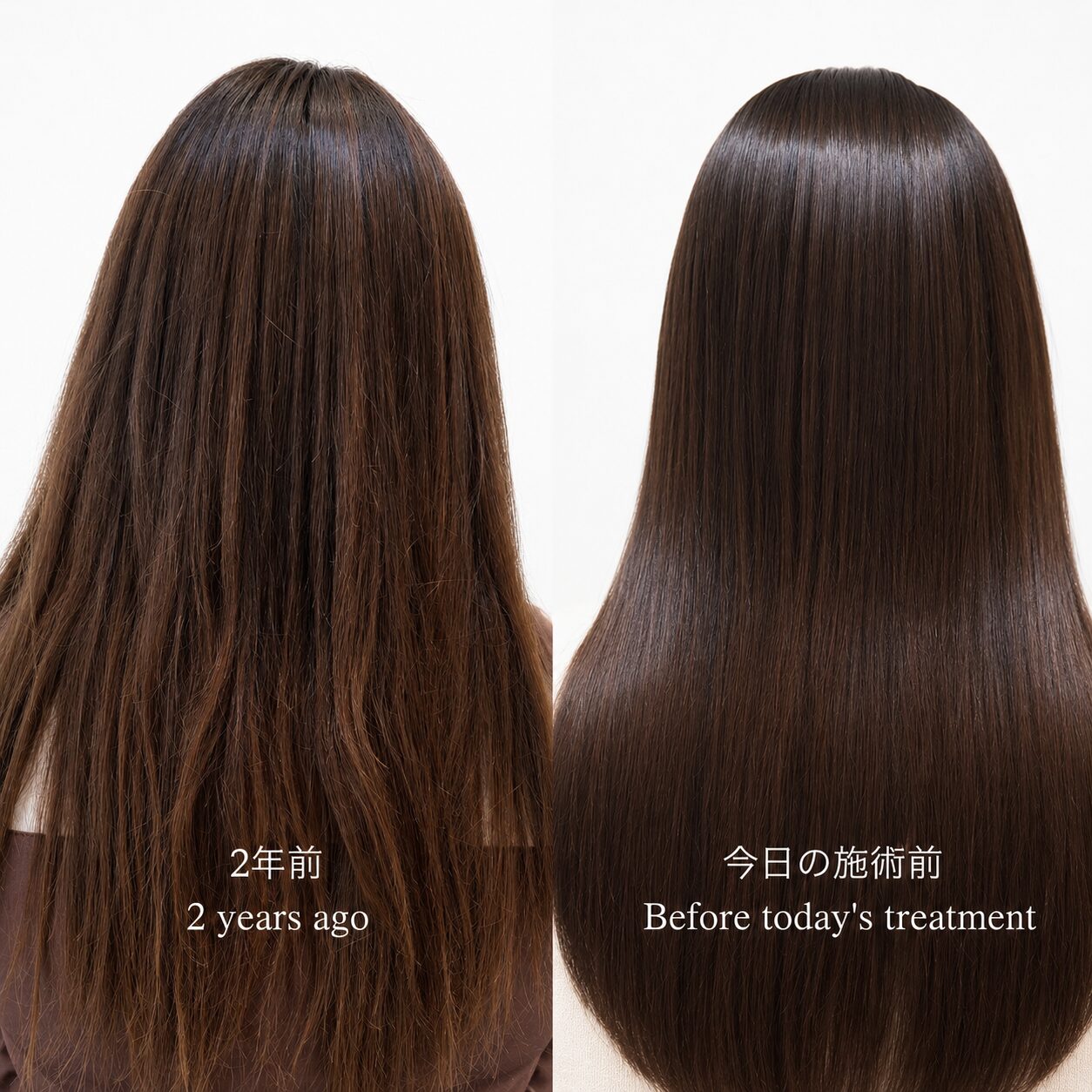
The most underserved hair type in Tokyo. The default move for many Japanese stylists when faced with curly hair is to blowdry it completely straight — because that’s what they know how to finish. If you want to keep your natural texture, find a stylist with specific international experience. If you want to eliminate the frizz and humidity problem entirely, Japanese acid straightening is genuinely effective and produces natural-looking results. Can Japanese salons handle curly hair? →
Fine, color-treated hair
Common American hair profile, and one that Tokyo’s humidity hits particularly hard. Fine hair absorbs atmospheric moisture quickly and loses shape fast. Color-treated hair has a more porous cuticle that amplifies the humidity effect. Silicone-free shampoo and proper blowdrying technique make a significant difference. Straightening is also an option for clients who want a more permanent solution. Hair straightening on damaged hair — what’s possible →
Heavily highlighted or bleached hair
The hair type that requires the most careful assessment in Japan. Japanese chemical treatments — including straightening — can behave unexpectedly on heavily processed hair. Always send a photo and disclose your full chemical history before booking any chemical treatment in Japan.
The Tokyo Humidity Problem: What Americans Don’t Expect
Many Americans come to Japan knowing it’s humid — but don’t fully anticipate how Tokyo’s specific climate will affect their hair. Japan’s rainy season (June–July) followed by high-humidity summer (August–September) means months of 80–90% relative humidity, often combined with heat. American products formulated for American climate conditions underperform significantly in these conditions. Full guide: American living in Tokyo and hair humidity →
How to Find the Right Salon
- Send a photo before booking — the most important step. Any stylist with real experience working with American clients will welcome this. Their response quality tells you more about their actual capability than any other indicator.
- Look for international work experience — stylists who have worked outside Japan, particularly in diverse cities, have worked with the range of hair types American clients bring
- Check portfolio diversity — if every photo shows straight dark Japanese hair, that’s the experience base
- Ask about acid-based techniques — for any chemical treatment, ask whether they use acid-based formulas. Any experienced stylist will be able to answer this specifically.
My Practice for American Clients
I’ve worked with American clients throughout my career — military families from Yokosuka and Atsugi, corporate expats from Minato and Shibuya, teachers and students from across the Kanto region. American hair varies enormously, and I’ve worked with the full range. Consultations are entirely in English. Before booking, send me a photo and tell me what’s been happening with your hair since you arrived in Japan.
If you are struggling with frizzy or unmanageable hair in Tokyo,
feel free to send me a photo on Instagram before booking.
Consultations fully in English. Honest assessment, no commitment required.
📍 Ginza / Yokohama · English consultation · One-on-one · 25 years experience
🕙 Yokohama: Mondays & 1st/3rd Thursdays · Tokyo (Ginza): Tue–Sun + 2nd & 4th Thursday · 9:00–18:30

コメント