※本記事にはアフィリエイトリンクが含まれます。Amazonのアソシエイトとして、当サイトは適格販売により収入を得ています。 / As an Amazon Associate, I earn from qualifying purchases.
hair straightening has become one of the most searched hair treatments in Japan. The marketing around it is almost universally positive — “gentle,” “damage-free,” “natural-looking.”
Most of that is true. But not all of it. And the parts that get left out are exactly what you need to know before you book.
I’ve been doing straightening treatments for over 25 years. Here’s the honest version.
The Part That’s True
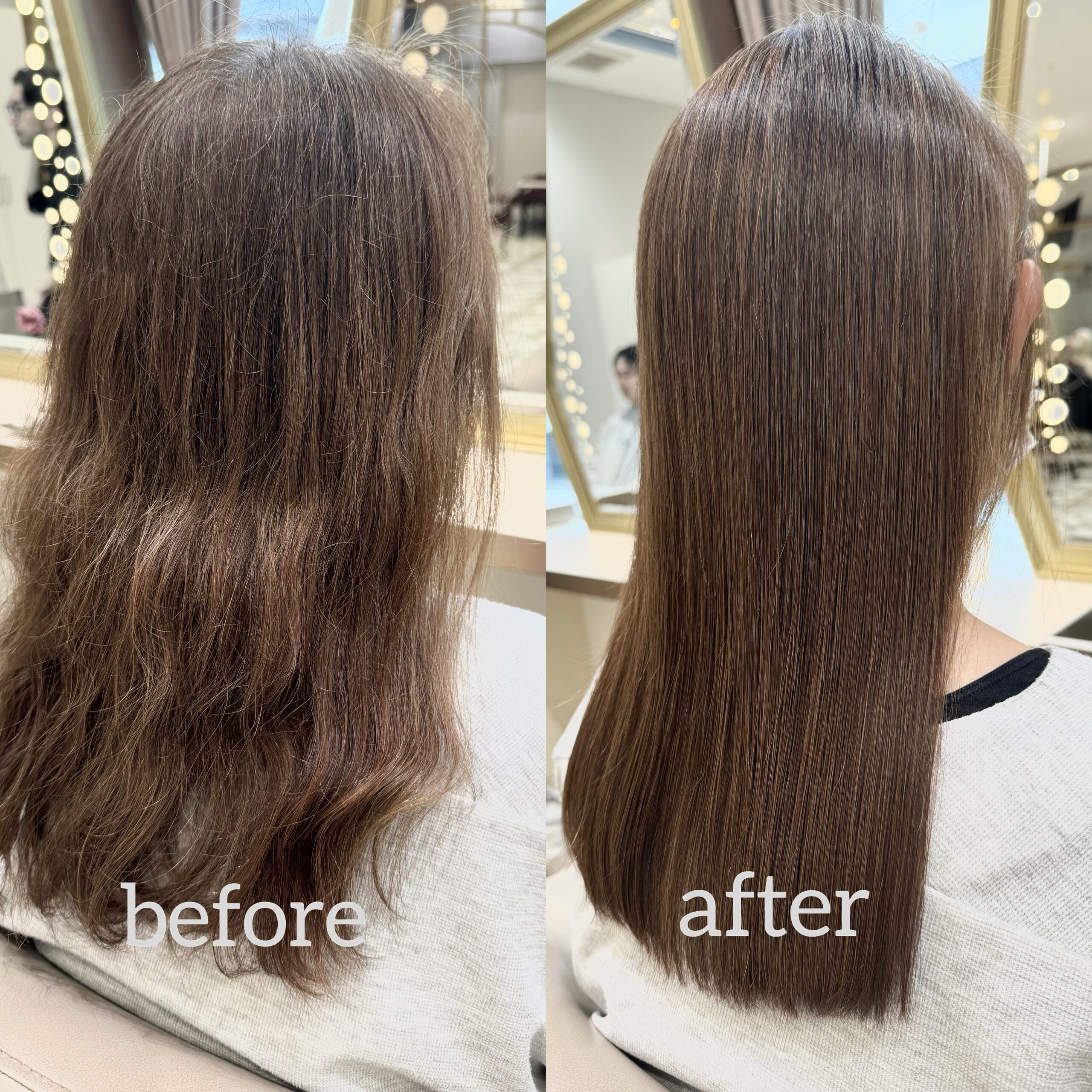
hair straightening genuinely is less damaging than traditional alkaline straightening — when done correctly.
The lower pH means the cuticle isn’t forced open as aggressively. The hair retains more of its natural protein and moisture during the process. The result is softer, more natural-looking, and more comfortable to live with day to day.
For most clients — especially those with color-treated hair, aging hair, or hair that has responded badly to traditional straightening — hair straightening is a significantly better option.
That part of the reputation is earned.
The Part That Gets Left Out
“Acid” doesn’t mean safe. It means the pH is different.
The chemistry of hair straightening still involves breaking the disulfide bonds inside your hair (what gives it its natural shape), then re-forming those bonds in a straight configuration. That’s the same fundamental process as alkaline straightening — just at a lower pH.
What this means in practice:
- The wrong chemical selection for your hair type can still cause serious damage
- Incorrect application technique — wrong saturation, wrong timing, wrong iron temperature — can leave hair dry, brittle, or broken at the ends
- Hair that has been bleached, repeatedly colored, or is already severely damaged needs careful assessment before any straightening treatment. “Acid” doesn’t automatically make it safe
The gentler chemistry of hair straightening gives the stylist less margin for error in some ways, not more. Because the chemical works more slowly, reading the hair correctly and knowing when to stop or adjust is more important — not less.
Why Results Vary So Much
If you search for hair straightening results online, you’ll find photos ranging from beautiful, natural-looking smooth hair to stiff, damaged, broken ends.
Same treatment name. Completely different results.
The difference is almost always the stylist.
Here’s what separates good results from bad ones:
Assessment before application The stylist should examine your hair carefully — texture, thickness, porosity, damage history, color history — before selecting a chemical. A stylist who applies the same formula to every client will get inconsistent results.
Chemical selection Even within “hair straightening,” there are dozens of different formulas at different pH levels and with different active ingredients. The right selection for fine, virgin hair is completely different from what’s appropriate for medium, bleached, or aging hair.
Application technique How the chemical is applied — the order, the saturation level, how it’s worked into the hair — affects how evenly it processes. Uneven application leads to uneven results.
Flat iron technique The temperature, speed, and angle of the flat iron pass determines the final shape and whether the hair is heat-stressed in the process. This is where many results go wrong — and it takes years of practice to do well consistently.
Pre-treatment Silicone buildup and oxidized lipids on the hair and scalp interfere with how the chemical penetrates. A proper pre-wash removes these before treatment. Many salons skip this step.
The Longevity Question
hair straightening, like all straightening treatments, is permanent in the sections of hair that have been treated. Your new growth will show your natural texture — but the treated portions will remain straight.
However, the quality of the result changes over time based on home care:
- Without proper care, straightened hair gradually loses moisture and becomes dry and rough within 2–3 months
- With the right shampoo, conditioning routine, and periodic in-salon treatments, the result can stay soft and smooth for 6–12 months before new growth makes re-treatment necessary
Most “the results faded quickly” complaints come down to home care — specifically using the wrong shampoo or skipping conditioning treatments.
What to Ask Before You Book
Here are the questions that will tell you a lot about whether a stylist knows what they’re doing:
“What formula do you use, and why is it appropriate for my hair?” A good answer explains the pH range and why it suits your specific hair condition. A bad answer is “we use the best hair straightening product.”
“Do you do a pre-treatment before applying the chemical?” The correct answer is yes — removing silicone and oxidized lipid buildup significantly improves results.
“How do you handle hair that’s been bleached or heavily colored?” A good answer acknowledges the additional complexity and explains how they assess and adjust. A bad answer is “no problem, hair straightening is safe for bleached hair.”
“Can I see before and after photos of clients with similar hair to mine?” This is completely reasonable to ask. A stylist who has done this successfully many times should have examples.
“What home care do you recommend after the treatment?” A good answer is specific — shampoo type, conditioning routine, how often to come back in. A vague answer suggests the stylist doesn’t think much about results beyond the session.
A Word on Bleached Hair
This deserves its own section because it comes up constantly.
hair straightening can be done on bleached hair — but it requires significantly more careful assessment and technique than on virgin or lightly colored hair.
Bleaching raises the porosity of the hair dramatically. High-porosity hair absorbs chemical faster, processes faster, and is more vulnerable to over-processing. The stylist needs to account for this by adjusting the formula, the application method, and the processing time.
I work with bleached hair regularly. But I assess each client individually before confirming whether treatment is appropriate — and I’m honest when it isn’t.
My Approach
Every client starts with a consultation where I examine your hair before recommending anything.
I explain what I’m going to do and why — including what formula I’m selecting and what I’m looking for during processing. I don’t rush. The pre-treatment step is non-negotiable. And if I think your hair needs recovery time before straightening, I’ll tell you that rather than proceed and hope for the best.
The goal isn’t just a good result today. It’s hair that’s in better condition a year from now than it was before you started.
Recommended Home Care
Shampoo: SBCP Raw Mineral Shampoo & Treatment — amino acid-based, silicone-free Weekly mask: SBCP Raw Mineral Hair Mask Hair oil: Kérastase Huile Chronologiste — pre-blowdry heat protection and shine Blowdryer: Bioprogramming Repronizer 4D Plus
✂️ Kenji’s Recommended Home Care Products SBCP Raw Mineral Shampoo & TreatmentBest post-straightening shampoo · silicone-free Amazon → Kérastase Huile Chronologiste Hair OilPre-blowdry heat protection & shine Amazon → SBCP Raw Mineral Hair MaskWeekly deep treatment for damaged hair Amazon → * These are products I personally use and recommend to clients. Links are Amazon affiliate links. Book an Appointment
💬 Contact me directly via WhatsApp (+81 80 9707 7119) or Instagram DM 📸 Instagram: @kenji_ginza_nhd 🕙 Hours: 8:30 – 18:30 (Yokohama: Mondays & 1st/3rd Thursdays / Tokyo: Tue–Wed, Fri–Sun + 2nd & 4th Thursday)
I respond within 24 hours. Feel free to send a photo of your hair — I’ll give you an honest assessment before you book.
🆕 New: Guides for International Clients in Japan


コメント