You sit down in the chair. You show the stylist a photo. You try your best to explain — in broken Japanese, with Google Translate open on your phone — what you want.
And two hours later, you leave looking nothing like the photo.
If you have naturally curly, wavy, or frizzy hair and you’ve spent any time in Japan, this story probably sounds familiar. It’s one of the most common complaints I hear from international clients — and it’s almost never the client’s fault.
Here’s what’s actually going on, and what you can do about it.
Why Japanese Salons Struggle with Curly Hair
This isn’t a criticism of Japanese stylists in general. The technical skill level in Japanese salons is genuinely high. But there’s a specific gap that creates problems for clients with non-straight hair.
The training gap
Japanese hairstylists are trained almost exclusively on straight, fine, single-texture Japanese hair. This is simply the reality of the market — the vast majority of their clients have hair that behaves in a particular way, and their training reflects that.
Curly, wavy, and coily hair behaves completely differently. It has different porosity, different elasticity, different shrinkage patterns, different responses to humidity, and different needs at every stage of cutting, treating, and styling. A stylist who has never worked with curly hair — or who has worked with it rarely — genuinely doesn’t have the framework to approach it well.
The cutting problem
This is where most curly hair disasters start. Curly hair needs to be cut differently from straight hair. The curl pattern changes the effective length of the hair — a cut that looks right when the hair is wet and stretched will look completely different once it dries and the curl springs back up.
Many Japanese stylists cut curly hair the same way they cut straight hair — section by section, often while wet, without accounting for how much the curl will shrink when dry. The result is uneven lengths, shapes that don’t work with the natural curl pattern, and a finished look that doesn’t match what was discussed.
The chemical treatment problem
Straightening, color, and perms all work differently on curly hair. Curly hair tends to be more porous than straight hair — meaning it absorbs chemicals faster, processes faster, and is more vulnerable to over-processing. A stylist who doesn’t account for this will apply the same timing and formula they use for every other client — which can lead to damage, uneven results, or both.
The communication problem
Even when the technical knowledge exists, communicating about curly hair in a second language is hard. The vocabulary for hair textures, curl patterns, shrinkage, and styling preferences is nuanced. “I want volume but not frizz” or “I want it to look natural when it dries” are concepts that require real understanding to translate into technique.
The Specific Things That Go Wrong
The blowout problem Many Japanese salons will blowdry curly hair completely straight as a matter of course — because that’s how they finish every client’s hair. If you haven’t explicitly said you want your natural curl to be preserved, you may find yourself with a blowout you didn’t ask for. Always specify upfront.
The thinning shears problem Thinning shears (すきバサミ) are used heavily in Japanese salons to reduce volume. On straight hair, this works well. On curly hair, it creates frizz — cutting the hair shaft at random points disrupts the curl pattern and makes the hair look and feel rough. If you have curly hair, ask your stylist not to use thinning shears.
The product problem Many products used in Japanese salons contain silicone — which coats the hair and makes it feel smooth immediately, but builds up over time and weighs down curls. If your curls have been feeling heavier and less defined than usual, silicone buildup from salon products may be part of the reason.
The “it’ll be fine” problem Some stylists, not wanting to turn away a client, will agree to a treatment that isn’t appropriate for the client’s hair type. A good stylist will tell you honestly if your hair isn’t ready for a particular treatment, or if what you’re asking for isn’t achievable with your current hair condition. If a stylist agrees to everything without asking questions, that’s worth noticing.
What Actually Works
Find a stylist who specifically mentions curly or non-Japanese hair This sounds obvious, but it narrows the field significantly. A stylist who regularly works with curly hair will mention it — on their website, in their Instagram captions, in how they respond to your initial inquiry.
Send a photo before you book This is the single most useful thing you can do. Send a photo of your hair in its natural state — not blown out, not straightened — and describe what you’re hoping for. A stylist who responds with specific, thoughtful questions is a stylist who understands what they’re looking at.
Ask about their approach to cutting curly hair Specifically: do they cut it wet or dry? Do they account for shrinkage? Have they worked with your specific curl pattern before? The answers will tell you a lot.
Be specific about what you don’t want Don’t want it blown out straight? Say so. Don’t want thinning shears? Say so. Don’t want product with silicone? Say so. The more specific you are upfront, the less room there is for misunderstanding.
Look for one-on-one sessions In a busy multi-client salon, the stylist is managing several people at once. Your consultation may be rushed. In a one-on-one session, the stylist can take the time to actually look at your hair, understand your curl pattern, and think carefully about how to approach it.
About Straightening Curly Hair
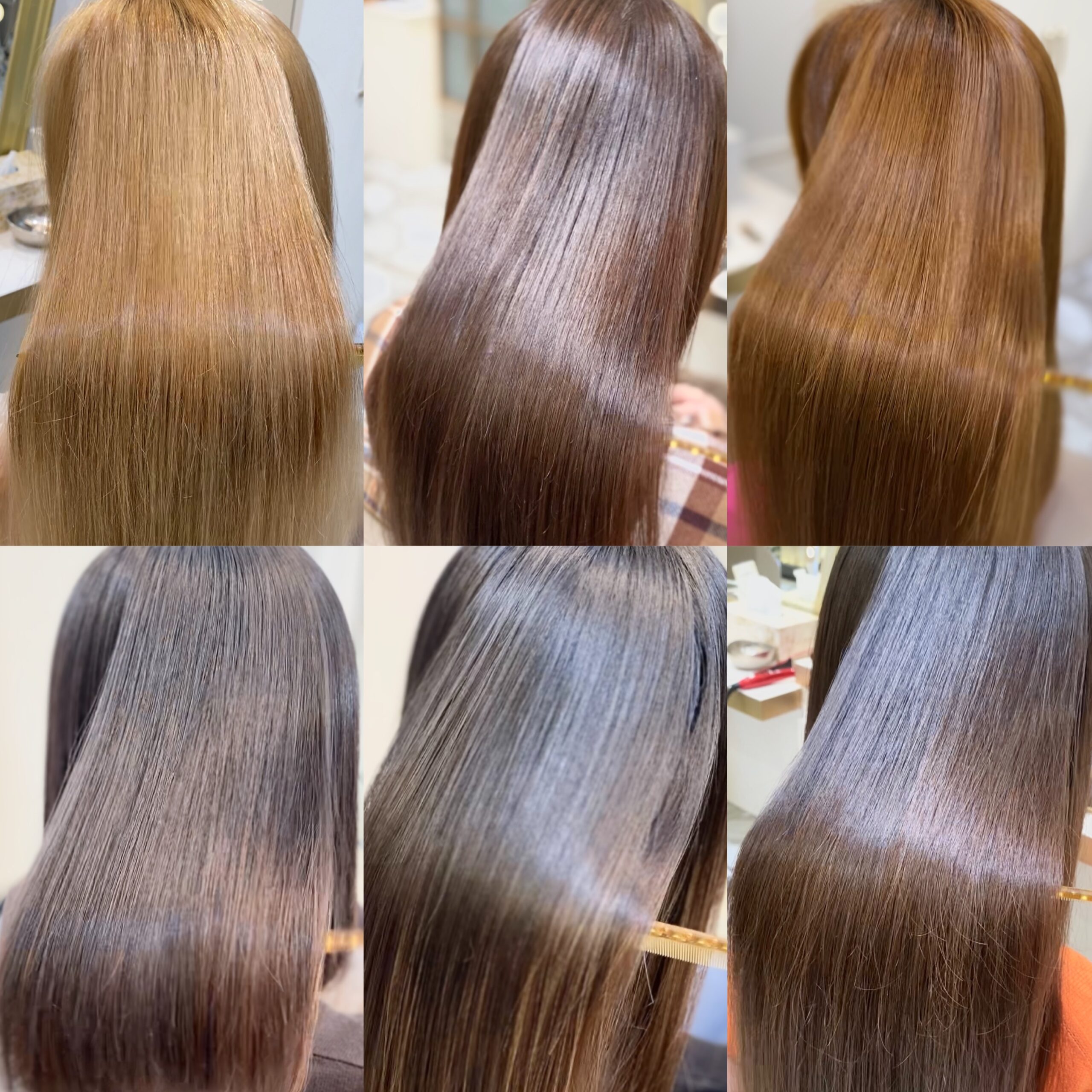
Some clients with curly hair don’t want to maintain their curls — they want smooth, straight hair. This is completely valid, and Hair Straightening can deliver excellent results on curly hair when done correctly.
The key word is “correctly.” Curly hair often has higher porosity than straight hair, which means the straightening chemical absorbs faster and the risk of over-processing is higher if the stylist isn’t adjusting for it.
I straighten curly hair regularly. But I always do a thorough assessment first — looking at the curl pattern, porosity, damage history, and color history before selecting the formula and technique. The approach for tight, thick, natural curls is completely different from what’s appropriate for loose waves or heat-damaged curly hair. Treating them the same way leads to inconsistent results at best, and real damage at worst.
If you’ve been told your curly hair “can’t” be straightened — or if you’ve had a bad straightening experience before — it’s worth getting a second opinion from someone who specifically works with curly hair.
My Approach to Curly Hair
I’m Kenji — a hairstylist with 25 years of experience, based in Tokyo with Monday sessions available in Yokohama.
I started my career in Yokohama’s Motomachi area — historically one of Yokohama’s most international neighborhoods — and later worked in Singapore, where I worked with clients from across Asia, Europe, the Middle East, and Africa. That experience gave me a genuine foundation in working with the full range of hair textures and curl patterns.
My sessions are one-on-one, conducted entirely in English. I take time at the start of every appointment to look at your hair — really look at it — before I recommend anything. And I’m honest when something isn’t right for your hair, rather than proceeding and hoping for the best.
If you have curly hair and you’ve had bad experiences at Japanese salons before, send me a message and tell me what happened. I’ll give you an honest assessment of what I can do — and what I’d approach differently.
Book an Appointment
💬 WhatsApp (+81 80 9707 7119) or Instagram DM 📸 Instagram: @kenji_ginza_nhd 🕙 Yokohama sessions: Mondays, 9:00–18:30 🕙 Tokyo sessions: Tuesday–Sunday, 9:00–18:30
Send me a photo of your hair in its natural state — no filter needed — and tell me what you’re looking for. I’ll respond within 24 hours.
Frequently Asked Questions
Can curly hair be straightened in Japan? Yes — Hair Straightening works well on curly hair when the stylist adjusts their technique for curl pattern and porosity. The results can be excellent. The key is finding someone who actually knows how to do it.
Will my curls come back after straightening? The straightened sections will remain straight permanently. New growth will show your natural curl. Most clients come back every 3–6 months depending on how fast their hair grows and how much of their natural texture they want to address.
I have mixed-race hair. Can you work with it? Yes. I regularly work with mixed hair types — combinations of Asian and Caucasian, Asian and African, and others. Mixed hair often has unique characteristics that require a genuinely customized approach. Send me a photo and I’ll give you an honest assessment.
What if I just want a good curly haircut — no straightening? Absolutely possible. A good cut for curly hair makes an enormous difference in how it looks and behaves day to day. Send me a photo and describe what you’re going for.
I’ve had multiple bad experiences at Japanese salons. Is it worth trying again? It depends on why the experiences went wrong. Send me a message and describe what happened — I’ll tell you honestly whether I think I can help and what I’d do differently.
コメント