※本記事にはアフィリエイトリンクが含まれます。Amazonのアソシエイトとして、当サイトは適格販売により収入を得ています。 / As an Amazon Associate, I earn from qualifying purchases.
Your hair looked fine in Singapore, Bangkok, or Manila — then Tokyo humidity completely changed it.
Many Southeast Asian clients tell me the same thing: “My hair was manageable before moving to Tokyo.” They’re right. It was. The hair didn’t change — the climate did. And Tokyo’s humidity, particularly during the rainy season and summer, is genuinely extreme by the standards of most countries.
Here’s the full story of one client’s experience — the hair type, the problem Tokyo created, what we did, and what the result actually looks like to live with day to day.
Why Southeast Asian Hair Reacts So Strongly to Tokyo’s Humidity
Southeast Asian hair — Thai, Filipino, Vietnamese, Indonesian, Malaysian, mixed Asian — tends to be thick, high-shine, and naturally resilient. In dry or moderate climates, these are advantages. In Tokyo’s summer humidity (regularly 80–90% relative humidity), the thickness means more surface area absorbing atmospheric moisture, and the natural wave or frizz tendency becomes dramatically amplified.
The result: hair that took 20 minutes in Bangkok requires 50 in Tokyo — and still doesn’t hold. This is the physics of hygroscopic materials in high humidity, not a hair problem. Learn more about why Tokyo humidity destroys hair →
The Client
A Thai national working in Tokyo, living in Japan for three years. Thick, naturally wavy hair — a consistent wave pattern throughout, high natural shine, strong strand diameter typical of Southeast Asian hair. No bleach history. Had colored her hair twice with a single-process brunette. No previous straightening.
She came to me not because her hair was particularly difficult at home — it wasn’t. She came because Tokyo’s summer had fundamentally changed her daily experience. Hair that required 20 minutes in Bangkok required 50 in Tokyo, and the result still wasn’t reliable.
The Problems Tokyo Created
- Morning routine: 45–50 minutes to get hair in an acceptable state for work
- Result held well indoors — but swelled and lost shape within 30 minutes outside during summer
- Rainy season (June–July) was particularly bad — she described avoiding outdoor plans because of her hair
- Had tried multiple Japanese anti-humidity products — none were adequate
- Strong preference: she did not want super straight hair — wanted to keep natural movement and volume
This profile — thick Southeast Asian hair, Tokyo humidity problem, wanting natural result not stiff straight — is one I see regularly. See why frizz happens in Japan →
The Consultation
Southeast Asian hair generally takes straightening particularly well — the strong protein structure means good resilience, and the natural shine becomes even more pronounced after treatment. The main consideration here was her preference for natural movement.
I was clear with her: acid straightening would significantly reduce the wave and frizz, but I would calibrate the technique to preserve volume and softness rather than pursuing maximum straightness. The iron temperature would be conservative, and I’d leave a deliberate margin at the roots to maintain root lift and natural-looking movement.
The Process
- Formula: Acid-based, pH 5.0 — appropriate for her hair’s condition and thickness. This is the low-damage modern approach — very different from old alkaline methods. Learn about modern Japanese straightening →
- Application: Mid-lengths and ends first; roots treated separately with a gentler formula to preserve volume
- Iron technique: 165°C, slower passes — deliberately preserving some soft movement rather than maximum straightening
- Total time: 4 hours 45 minutes (longer than average due to hair thickness and length)
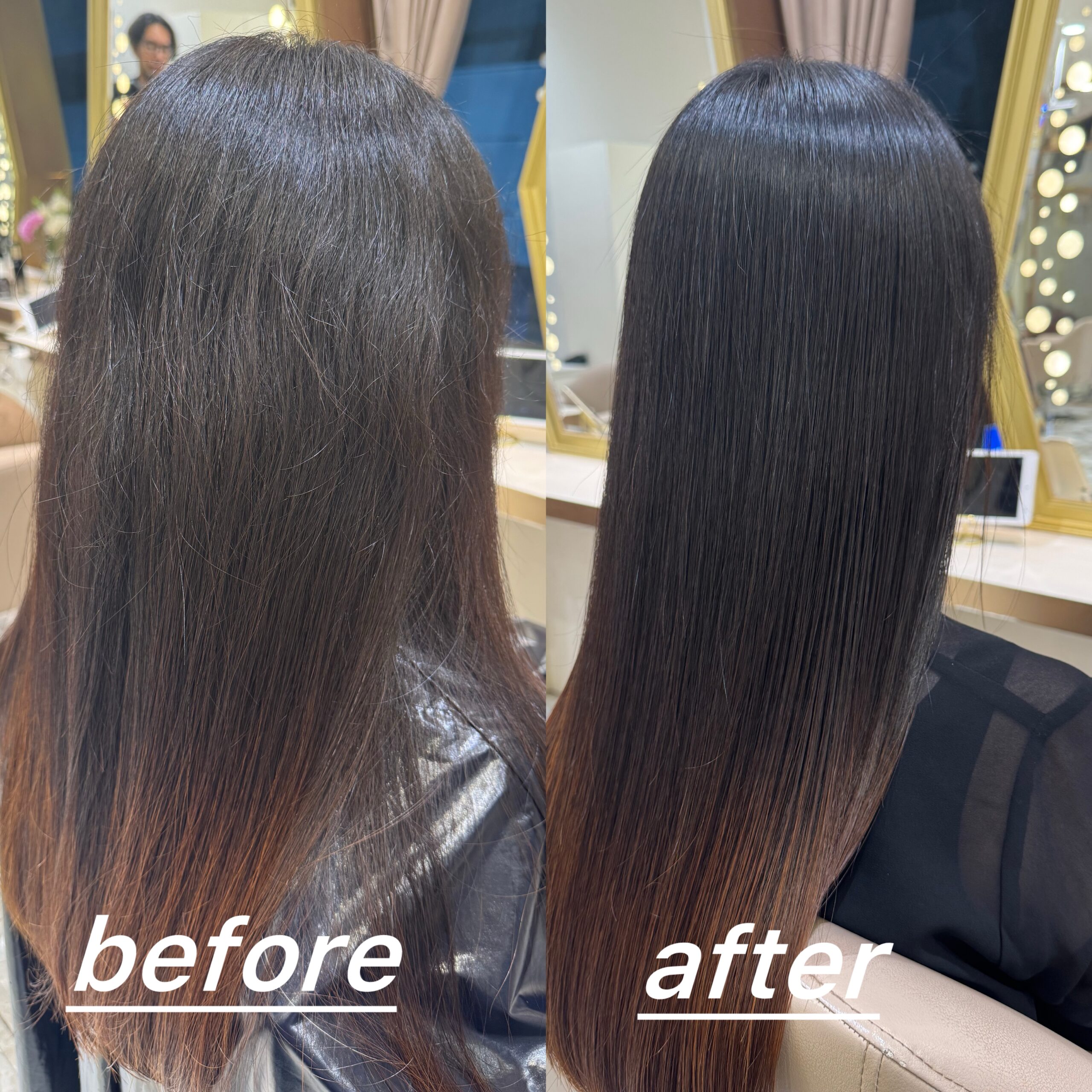
The Result: Before and After
BEFORE — Tokyo Humidity Problem
Morning routine: 45–50 min
Holds indoors only · Loses shape within 30 min outside in summer · Rainy season unbearable · Avoided outdoor plans · Multiple products failed
AFTER — 4 Months Later
Morning routine: 10–12 min
Holds shape through full day · Rainy season no longer a problem · Natural volume and movement preserved · High shine · Returned for root touch-up at 5 months
At the 4-month follow-up, she described the treatment as the best decision she’d made since moving to Tokyo. The natural movement she’d wanted was there — the hair didn’t look processed, just smooth and well-behaved.
Aftercare That Extended the Result
The aftercare choices made a significant difference to how long the result lasted. The two most important changes: switching to silicone-free shampoo and using a heat protection oil before every blowdry. See the best shampoos for after straightening →
✂️ Aftercare Products Used
Is This Your Situation? Filipino, Thai, Vietnamese, Indonesian, Malaysian, or Mixed Asian Hair in Tokyo?
Southeast Asian hair straightens particularly well because of its strong natural protein structure. The natural shine becomes even more pronounced after treatment. If Tokyo’s humidity is affecting your daily life and you want to understand what’s realistically possible for your specific hair type, send me a photo before booking.
Not sure if straightening is right for you? Compare Japanese straightening vs keratin treatment →
If you are struggling with frizzy or unmanageable hair in Tokyo,
feel free to send me a photo on Instagram before booking.
Honest assessment of what’s possible for your hair type. No commitment required.
📍 Ginza / Yokohama · English available · One-on-one private salon
🕙 Yokohama: Mondays & 1st/3rd Thursdays · Tokyo (Ginza): Tue–Sun + 2nd & 4th Thursday · 8:30–18:30
English-speaking stylist · Ginza & Yokohama
Need a hair straightening specialist in Tokyo?
I help foreigners with curly, wavy, frizzy and color-treated hair — consultation in English. Send a photo for an honest quote, no fee.
Book on WhatsApp → Services & pricing →

コメント