※本記事にはアフィリエイトリンクが含まれます。Amazonのアソシエイトとして、当サイトは適格販売により収入を得ています。 / As an Amazon Associate, I earn from qualifying purchases.
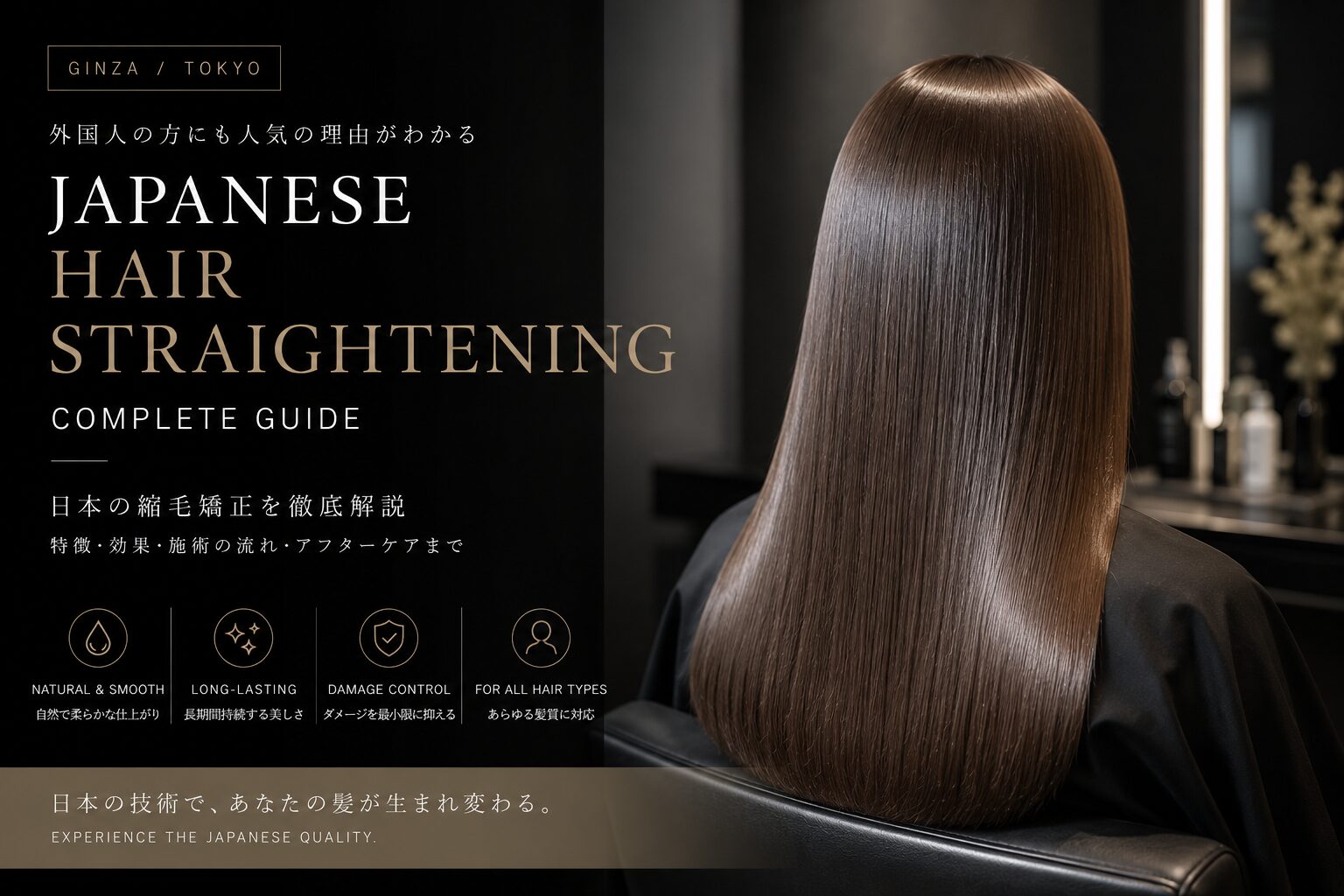
Japanese hair straightening is one of the most effective permanent hair smoothing treatments available anywhere in the world. It’s also one of the most misunderstood — surrounded by outdated information, exaggerated claims, and genuine confusion about what modern techniques actually involve.
This guide covers everything: what the treatment actually is, how it works scientifically, who is and isn’t a good candidate, what realistic results look like on different hair types, what it costs and how long it takes, what can go wrong and how to prevent it, and how to find a stylist who can deliver what they promise.
I’m Kenji — a Tokyo-based hairstylist with 25 years of experience, including years working in Singapore with clients of all nationalities and hair types. I’ve performed this treatment thousands of times. Everything in this guide comes from that direct, sustained experience.
- What Is Japanese Hair Straightening?
- The Science: How It Works
- Alkaline vs Acid: The Most Important Distinction
- Who Is a Good Candidate?
- Realistic Results by Hair Type
- Time and Cost
- Risks and How to Prevent Them
- The Critical 48 Hours After Treatment
- Long-Term Aftercare
- Japanese Straightening vs Other Treatments
- How to Find the Right Stylist in Japan
- Frequently Asked Questions
- Book an Appointment
What Is Japanese Hair Straightening?
Japanese hair straightening — known in Japan as 縮毛矯正 (shukumou kyousei) — is a two-step chemical treatment that permanently restructures the disulfide bonds within the hair fiber to make curly, wavy, or frizzy hair straight.
Unlike keratin treatments or Brazilian blowouts, which coat the outside of the hair with a smoothing film that eventually washes out, Japanese straightening works from inside the hair shaft. The bonds that determine your hair’s natural curl pattern are chemically reconfigured. The straightened sections of hair remain straight permanently.
The Science: How It Works
Hair texture is determined by disulfide bonds — chemical connections between sulfur atoms within the hair’s keratin protein structure. Japanese straightening works in three phases:
- Softening — A reducing agent breaks the existing disulfide bonds, making the hair fiber pliable and reshapeable.
- Restructuring — A flat iron restructures the hair in a straight configuration while the bonds are broken. This is the most technically demanding step.
- Fixing — A neutralizing solution reforms the disulfide bonds in their new straight configuration, permanently.
Alkaline vs Acid: The Most Important Distinction
| Property | Alkaline (Traditional) | Acid (Modern) |
|---|---|---|
| pH range | 8–10 | 4–6 |
| Result texture | Stiff, artificial | Soft, natural |
| Damage level | Higher | Lower |
| Bleached hair | Not suitable | Possible with care |
| 2026 recommendation | Legacy use only | Standard |
The “stiff” or “plastic” straight hair that gave Japanese straightening a negative reputation in the 1990s came almost entirely from over-alkaline formulas. Modern acid-based treatment produces results that most people can’t identify as chemically treated — the hair moves naturally, has volume, and looks genuinely healthy.
Who Is a Good Candidate?
Good candidates
- Hair with moderate to strong natural curl or wave
- Hair in reasonably good condition (not heavily damaged)
- Previously color-treated hair (non-bleached)
- All hair ethnicities — Asian, European, South Asian, Southeast Asian, mixed heritage
- Previously straightened hair — touch-up on new root growth only
Requires extra care or not recommended
- Heavily bleached hair — requires individual assessment
- Very fine hair with existing damage — higher breakage risk
- Within 4 weeks of another strong chemical treatment
- During pregnancy — consult your doctor first
Realistic Results by Hair Type
Fine, slightly wavy hair
The most seamless results. Frizz disappears, the hair becomes smooth and reflective, and blowdrying time drops by 50–70%. Most people cannot tell the hair has been treated.
Medium texture, moderate curl or wave
The most common type I see among international clients in Tokyo and Yokohama. The transformation is visible but doesn’t look artificial — the hair is noticeably straighter with natural movement remaining. Results typically last 6–8 months.
Thick hair, strong curl
The most dramatic transformation — and often the most satisfying for clients who have struggled with their hair for years. Correct technique produces a result that is soft and surprisingly natural. This is where stylist experience matters most.
Previously colored or highlighted hair
Results depend on the degree of previous processing. Lightly colored hair straightens well. Heavily damaged hair requires individual assessment. A thorough pre-appointment consultation is non-negotiable.
Time and Cost
| Hair length | Time | Cost range (JPY) |
|---|---|---|
| Short (above chin) | 2.5–3.5 hrs | ¥15,000–¥33,000 |
| Medium (chin to shoulder) | 3–4 hrs | ¥33,000–¥40,000 |
| Long (below shoulder) | 4–6 hrs | ¥33,000–¥60,000 |
| Root touch-up only | 2–3 hrs | ¥15,000–¥35,000 |
Risks and How to Prevent Them
- Chemical damage (over-processing) — Choose an experienced stylist who does individual assessment. Walk away from any stylist who doesn’t examine your hair in detail before starting.
- Heat damage — This is the stylist’s responsibility. An experienced stylist selects the correct flat iron temperature for your specific hair condition.
- Uneven result — Ask to see before-and-after photos of actual clients with similar hair to yours.
- Cumulative damage from repeated treatment — A correct touch-up applies new product only to the new root growth, never to already-straightened sections.
The Critical 48 Hours After Treatment
- Do not wash your hair — the bonds are still completing stabilization
- Do not tie, clip, or pin your hair — marks can become permanent kinks
- Do not tuck hair behind your ears
- If hair gets wet — blowdry immediately on low heat
- Use a silk or satin pillowcase for sleeping
Long-Term Aftercare
Switch to silicone-free shampoo — the most important change
Most commercial shampoos contain silicone (dimethicone, cyclomethicone) that builds up on the hair shaft over weeks, gradually degrading the straightening result. Clients who switch to silicone-free shampoo consistently report their results lasting 1–2 months longer.
SBCP Raw Mineral Shampoo
Most recommended · Silicone-free · Extends results 1–2 months
Heat protection oil before every blowdry
Straightened hair is more vulnerable to daily heat damage than untreated hair. A non-silicone oil rated to at least 230°C applied before blowdrying protects the cuticle and extends the quality of the result significantly.
Kérastase Huile Chronologiste
Used in Kenji’s salon every day · 230°C protection · Silicone-free
Additional rules
- Never air dry — always blowdry with a concentrator nozzle
- 38°C water maximum — hot water degrades the result faster than almost any other factor
- Deep conditioning mask 1–2× weekly — the Kérastase Masque Chronologiste is what I recommend
Japanese Straightening vs Other Treatments
| Treatment | Duration | Mechanism | Curl effect |
|---|---|---|---|
| Japanese straightening | Permanent | Internal bond restructuring | Complete |
| Keratin / Brazilian blowout | 2–4 months | Surface coating | Partial |
| Acid heat treatment (酸熱) | 2–4 months | Partial restructuring | Frizz reduction only |
| Relaxer | Permanent | Bond breaking (alkaline) | Complete |
How to Find the Right Stylist in Japan
- Check their portfolio for your hair type — a stylist who works exclusively on straight Japanese hair may not have the experience for your curl pattern
- Send a photo before booking — any experienced stylist welcomes this. Their response tells you everything about the consultation you’ll receive.
- Ask about acid-based technique — if they don’t know the pH of the formulas they use, that’s a signal.
- Look for international work experience — stylists who have worked abroad have worked with wider hair type ranges
- A stylist who can say “your hair isn’t a good candidate right now” is more trustworthy than one who says yes to everything
Frequently Asked Questions
Can I color my hair after straightening? Yes — wait at least 2 weeks, ideally 4 weeks.
Can I curl straightened hair? Yes — after the initial 48-hour setting period. The curl won’t last as long as on untreated hair.
How often do I need touch-ups? Most clients return every 4–6 months when new root growth becomes noticeable.
Will it work on my hair? Send me a photo — I’ll tell you honestly.
Is it safe during pregnancy? Consult your doctor first. Many practitioners decline as a precaution.
What’s the difference from a relaxer? Both permanently straighten, but use different chemistry. Relaxers use high-pH alkaline agents; Japanese straightening uses thioglycolate or acid-based formulas, plus a mandatory flat iron step. Results, texture, and maintenance differ.
Book an Appointment
I offer one-on-one sessions in Tokyo and Yokohama. Send me a photo of your current hair before booking — I’ll tell you honestly whether straightening is right for your hair, what the realistic result looks like, and what the process involves.
🕙 Yokohama: Mondays & 1st/3rd Thursdays, 8:30–18:30 · Tue–Fri 20:00–23:30
🕙 Tokyo (Ginza): Tuesday–Sunday + 2nd & 4th Thursday, 8:30–18:30
コメント