※本記事にはアフィリエイトリンクが含まれます。Amazonのアソシエイトとして、当サイトは適格販売により収入を得ています。 / As an Amazon Associate, I earn from qualifying purchases.
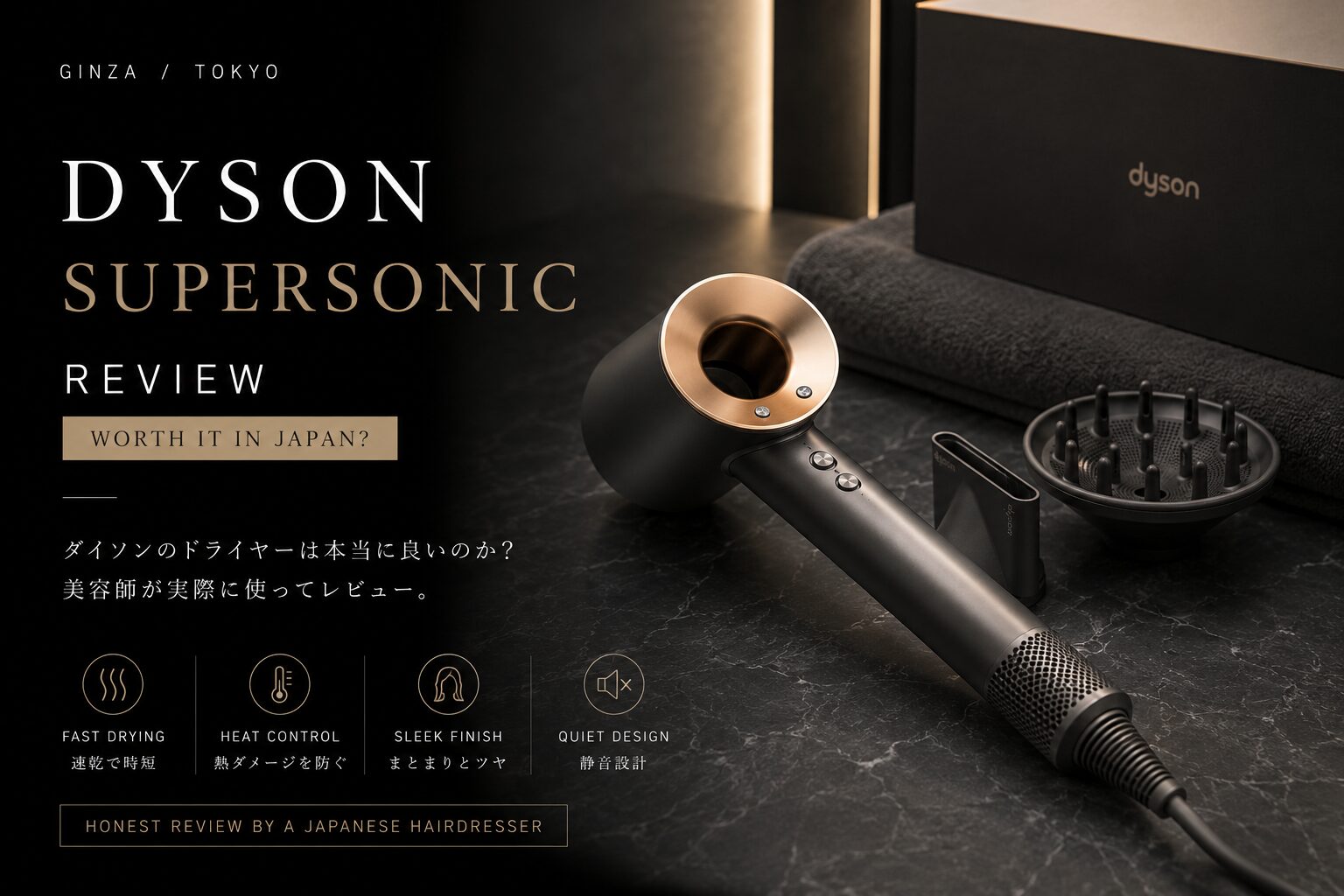
The Dyson Supersonic is the most globally recognized premium hair dryer — and for good reason. But is it the right choice for life in Japan specifically? After years of professional experience with all three major premium dryers available here, here’s my honest assessment.
What Makes the Dyson Supersonic Different
Dyson’s engineering approach is genuinely clever: a small, powerful digital motor sits in the handle rather than the head, making the dryer significantly lighter and better balanced than its performance would suggest. The Air Multiplier technology produces high-velocity airflow that dries hair faster than most conventional dryers. And the intelligent heat control — measuring air temperature 40 times per second and adjusting to stay below damaging thresholds — is a real feature, not marketing language.
Performance in Japan
Drying Speed: Best of the Three
The Dyson dries faster than both the Bioprogramming Repronizer and the Panasonic nanoe. For thick or long hair where drying time is a priority, this matters. In a busy morning routine, the speed advantage is real.
Heat Control: Genuinely Protective
The intelligent heat control works. Hair doesn’t overheat even on the highest setting in the way it can with cheaper dryers. For colored or straightened hair where heat damage accumulates over daily use, this is meaningful protection.
Attachments: Actually Useful
The magnetic attachments — concentrator, smoothing nozzle, diffuser — attach and detach quickly and are genuinely well-designed. The diffuser in particular is excellent for clients with wavy or curly hair who want to enhance their natural texture rather than blowdry it straight.
Frizz Control: Good, But Not Best
In head-to-head comparison on clients, the Dyson produces very good frizz control in Japan’s humidity — better than most conventional dryers, and comparable to the Panasonic nanoe. The Bioprogramming Repronizer edges it out on this specific measure, in my experience.
The Dual Voltage Advantage: Critical for Expats
This is where the Dyson wins decisively for a specific audience. The Supersonic is genuine dual voltage (100–240V) — it works in Japan on 100V and in your home country on 110V or 240V without any converter. If you’re an expat who will eventually leave Japan, this is a significant practical advantage. The Repronizer is Japan’s 100V only. Taking it abroad means buying a converter and reducing its lifespan.
Dyson vs Repronizer vs Panasonic: Honest Comparison
| Criteria | Dyson Supersonic | Repronizer 4D+ | Panasonic nanoe |
|---|---|---|---|
| Drying speed | ⭐⭐⭐⭐⭐ | ⭐⭐⭐⭐ | ⭐⭐⭐ |
| Moisture retention | ⭐⭐⭐⭐ | ⭐⭐⭐⭐⭐ | ⭐⭐⭐⭐ |
| Dual voltage | ✅ Yes | ❌ No | ⚠️ Varies |
| Value for money | ⭐⭐⭐ | ⭐⭐⭐ | ⭐⭐⭐⭐⭐ |
| Best for | Expats who travel | Long-term Japan residents | Budget-conscious |
Who Should Buy the Dyson Supersonic
- Expats who will leave Japan within 1–3 years — dual voltage means you can take it home and use it immediately
- Frequent international travelers — works anywhere without a converter
- Thick or long hair where drying speed matters
- Anyone who wants the most versatile premium dryer
Who Should Consider the Repronizer Instead
- Long-term Japan residents (3+ years) who prioritize daily hair quality over portability
- Clients with straightened, colored, or aging hair where moisture retention is the priority
✂️ All Three Options
🕙 Yokohama: Mondays & 1st/3rd Thursdays · Tokyo: Tue–Sun + 2nd & 4th Thursday · 8:30–18:30
English-speaking stylist · Ginza & Yokohama
Need a hair straightening specialist in Tokyo?
I help foreigners with curly, wavy, frizzy and color-treated hair — consultation in English. Send a photo for an honest quote, no fee.
Book on WhatsApp → Services & pricing →
コメント