Japanese hair straightening has a reputation for delivering some of the smoothest, longest-lasting results in the world.
But if your hair isn’t straight and fine to begin with — if it’s curly, wavy, frizzy, thick, or color-treated — you’ve probably wondered: does it actually work for hair like mine?
The honest answer is yes. But the technique matters enormously.
What Makes Japanese Hair Straightening Different
Most people outside Japan first encounter the term “Japanese straightening” as a single category. In reality, there are two fundamentally different approaches:
Traditional alkaline straightening (縮毛矯正) The older method. Strong, effective, and long-lasting — but uses high-alkaline chemicals that can be harsh on hair that’s already been colored, bleached, or chemically treated. The result tends to be very straight but can look stiff and unnatural if not done well.
Hair Straightening (縮毛矯正) The modern evolution. Uses lower pH chemistry that works with the hair’s natural structure rather than against it. The result is smoother, softer, and more natural-looking — and it’s significantly gentler on hair that has been bleached or color-treated.
For most non-Japanese clients, Hair Straightening is the better choice. Here’s why.
How Non-Japanese Hair Responds Differently
Japanese stylists are primarily trained on straight, fine, single-texture Japanese hair. Non-Japanese hair — whether Caucasian, South Asian, Southeast Asian, African, Middle Eastern, or mixed — often has different properties:
- Higher porosity — hair absorbs and releases chemicals faster, which affects timing and product selection
- Different curl patterns — from loose waves to tight coils, each requiring different application technique
- Varied thickness — thicker strands need different saturation and processing time
- Prior chemical history — bleach, perms, relaxers, and hair dye all affect how the hair responds
A stylist who doesn’t account for these differences will get inconsistent results — or worse, damage.
The key is not just knowing the chemicals, but knowing how to read the hair in front of you and adapt accordingly.
Real Results: 9 Clients, 9 Different Hair Types
The photos below show results from 9 different clients — each with different hair texture, thickness, and color history.
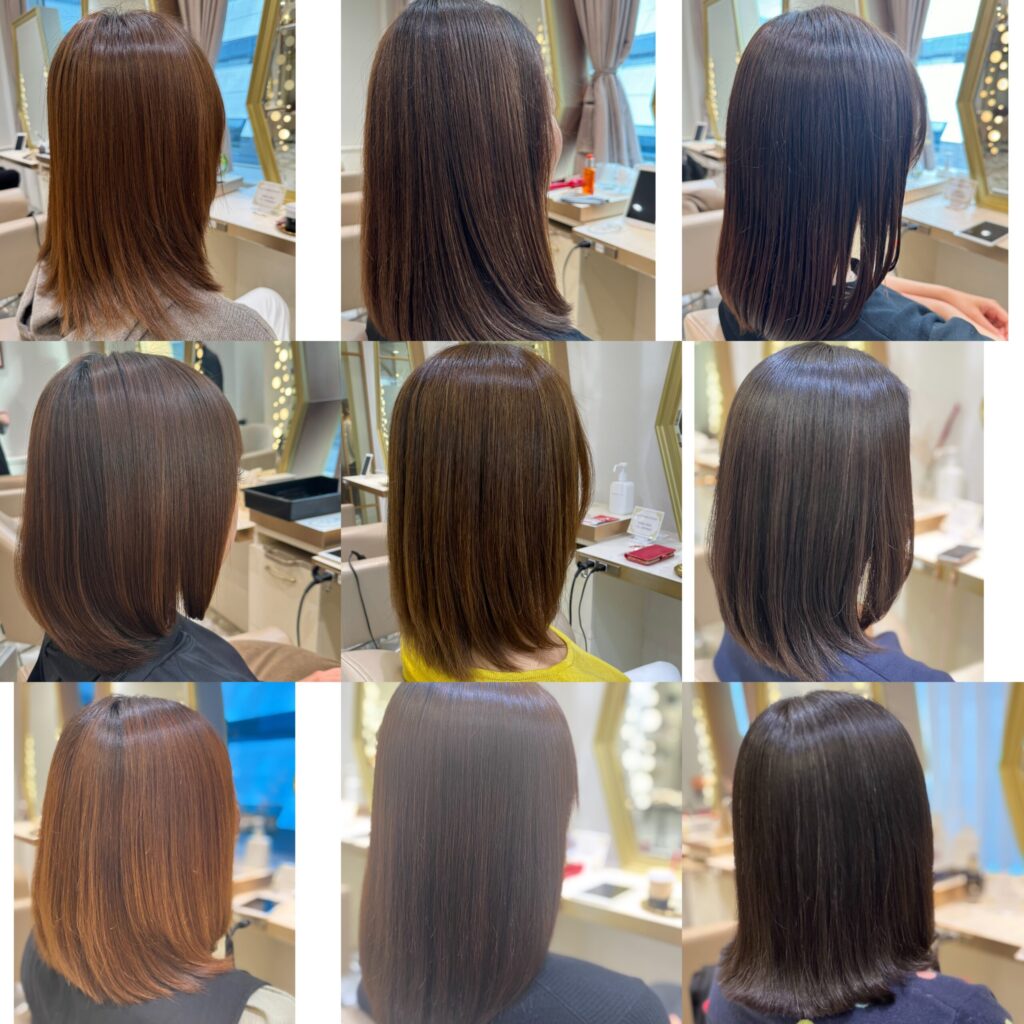
What you’ll notice across all of them: the finish is smooth and natural, not flat or plastic-looking. That’s the difference between a well-executed Hair Straightening and a rushed one.
Each of these clients came in with different concerns — some had never straightened before, some had bad experiences elsewhere, some had colored or bleached hair and assumed straightening wasn’t possible for them.
Common Questions from Non-Japanese Clients
“I have curly hair. Will it actually go straight?” Yes — Hair Straightening works on curly hair. The degree of straightening can be adjusted based on your preference. Some clients want completely straight hair; others want to keep some natural movement while eliminating frizz. We discuss this during consultation.
“My hair is bleached. Is straightening possible?” In many cases, yes. Bleached hair requires extra care in product selection and timing, but it’s not automatically a barrier. I assess each client individually before confirming whether treatment is appropriate.
“Will it damage my hair?” Any chemical process carries some degree of risk. The difference is in how the stylist manages that risk. Hair Straightening, when done correctly, is significantly less damaging than alkaline methods. I also perform a pre-treatment assessment to minimize risk for each individual.
“How long does it last?” Typically 6–12 months depending on your hair growth rate and how you care for it at home. The straightened portion remains straight permanently — new growth will show your natural texture over time.
“Can I color and straighten on the same day?” In most cases, yes. I often combine Hair Straightening with color or gray coverage in a single session.
“How long does the session take?” For most clients: 3–4 hours. Longer hair or more complex cases may take longer.
Why One-on-One Matters
In most Japanese salons, your hair will be handled by multiple people — a junior for washing, an assistant for product application, the senior stylist for cutting, another for finishing.
For non-Japanese clients, this creates a communication problem. The person making the decisions about your hair may not be the person you spoke to at the start.
My sessions are one-on-one from start to finish. I do the consultation, apply the treatment, cut, and finish your hair personally. You always know who is responsible — and you can ask questions at any point.
How to Book
Send me a message with a photo of your current hair and a brief description of what you’re looking for. I’ll give you an honest assessment — including whether I think the treatment is appropriate for your hair type — before you commit to anything.
💬 WhatsApp or Instagram DM 📸 Instagram: @kenji_ginza_nhd 🕙 KENJI’s Appointment Hours: 8:30 AM – 6:30 PM (from 8:00 AM on request) (Yokohama: See Current Schedule → / Tuesday–Sunday in Tokyo)
I respond within 24 hours.

コメント