Is Hair Straightening Dangerous? A Hairstylist’s Honest Risk Assessment

Client Stories

Search “is hair straightening dangerous” and you’ll find a lot of alarming articles.

Some of them have a point. Others are exaggerated, outdated, or written by people who don’t actually do straightening for a living.

After 23 years and over 30,000 straightening treatments, here’s my honest assessment of the risks — what’s real, what’s overstated, and what actually determines whether the treatment is safe for you.


Risk 1: Chemical Damage — Real, But Manageable

Hair straightening works by chemically breaking and reforming the internal bonds of your hair. This is true of both traditional alkaline straightening and modern acid straightening. No chemical process is entirely without risk.

The question isn’t “is there risk?” — it’s “how much risk, and what causes it?”

What increases risk:

  • Using a formula that’s too strong for your hair’s current condition
  • Leaving the chemical on too long
  • Applying heat (flat iron) at too high a temperature or too many passes
  • Treating hair that’s already severely damaged or over-processed
  • Skipping the pre-treatment step (which removes silicone and oxidized lipid buildup that can cause uneven processing)

What reduces risk:

  • Thorough assessment of your hair’s condition before any chemical is applied
  • Selecting the right formula for your specific hair — not a one-size-fits-all approach
  • Applying different formulas to different sections based on their damage level
  • Careful iron work — temperature, speed, and angle all matter
  • Proper conditioning at every stage of the process

Acid straightening, when done correctly, significantly reduces the chemical stress compared to traditional alkaline methods. But “acid” doesn’t mean risk-free — it means the chemistry is gentler when executed properly.


Risk 2: The Stylist Variable — This Is the Real Issue

Most straightening disasters don’t come from the treatment itself. They come from the person doing it.

Hair straightening — especially acid straightening — requires:

  • The ability to read hair condition accurately (porosity, elasticity, damage level, color history)
  • Knowledge of chemical selection across different pH ranges and formulas
  • Application technique that ensures even saturation without over-saturating damaged sections
  • Iron technique that reshapes the hair without causing heat stress
  • Experience with different hair types — Asian, Caucasian, South Asian, African, mixed

A stylist who learned one technique and applies it the same way to every client will get inconsistent results. The same formula that works beautifully on one person’s hair can cause serious damage on another’s — if the stylist isn’t adjusting for the difference.

This is why I always say: choose the stylist, not the salon name.


Risk 3: Bleached and Color-Treated Hair

This is where the most caution is warranted — and also where the most misinformation exists.

The common claim: “You can’t straighten bleached hair.”

The reality: You can, in many cases — but it requires significantly more careful technique than on virgin or lightly colored hair.

Bleaching raises hair porosity dramatically. High-porosity hair absorbs chemical faster and is more vulnerable to over-processing. If a stylist applies the same formula and timing to bleached hair as they do to unbleached hair, the result can be damaged or broken hair.

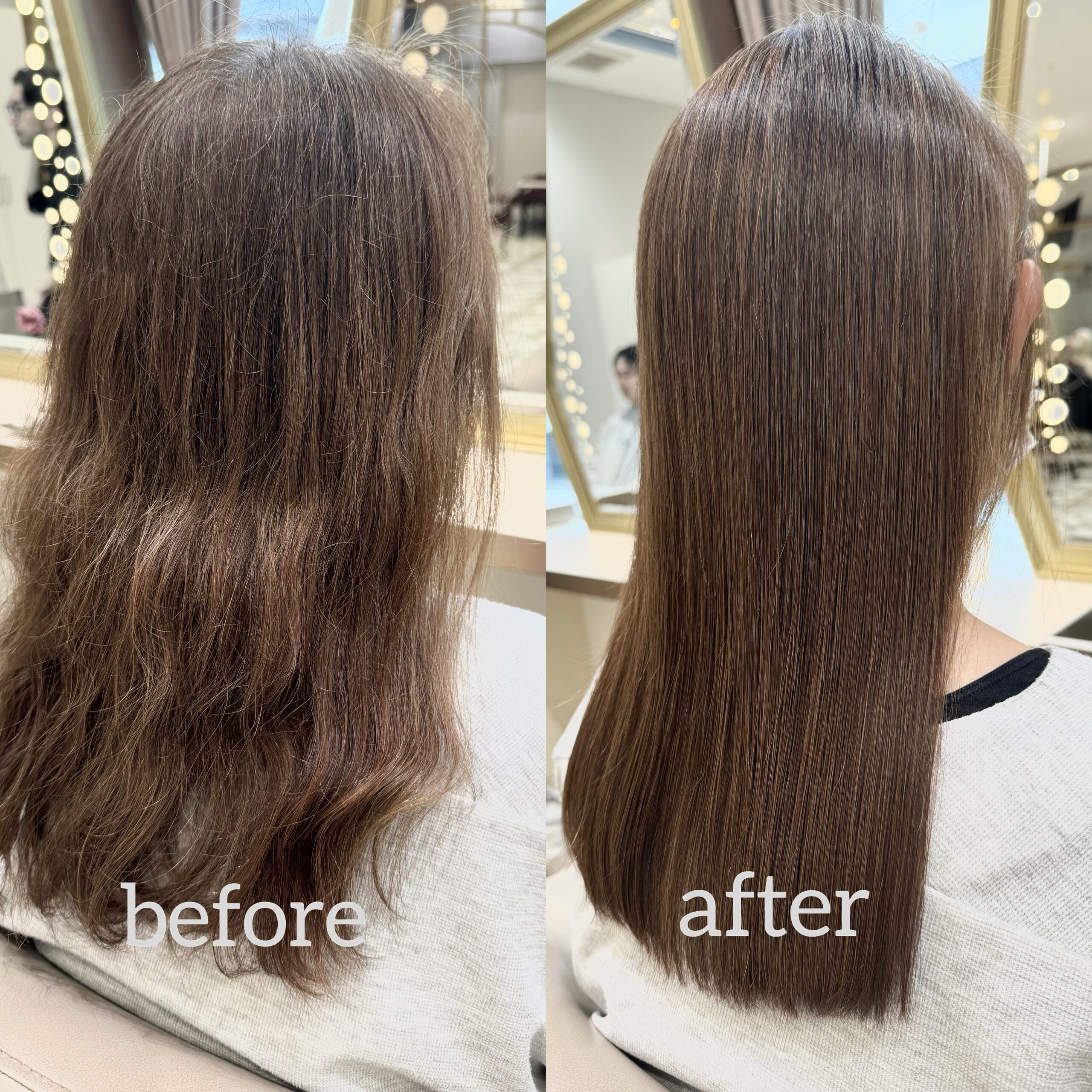
Adjusted correctly — different formula, different timing, additional pre-treatment, more careful iron work — bleached hair can be straightened successfully. I do it regularly.

The important thing is honest assessment before you start. If your hair is too damaged to treat safely, a good stylist will tell you that and recommend a recovery plan instead.


Risk 4: Home Care After Treatment

This is the risk that almost never gets mentioned in “is straightening dangerous?” articles — but it’s one of the most common causes of deterioration.

Straightened hair needs specific care to maintain its condition:

  • Silicon-based shampoos build up on straightened hair over time and weigh it down, dulling the result and eventually causing the hair to feel rough and dry
  • Hot water (above 40°C) forces the cuticle open repeatedly, accelerating moisture loss
  • Skipping conditioner after straightening leaves the hair without protection between washes
  • No heat protection before blowdrying causes cumulative heat damage that shows up months later

The treatment can be perfect — and still look poor three months later if home care is wrong.


Risk 5: Frequency

Straightening too often is a real risk that’s easy to avoid.

Re-treating hair before there’s enough new growth (typically less than 2.5–3 cm) means overlapping chemicals onto previously treated sections. This accumulates damage over multiple sessions.

The correct approach: treat only the new growth. Wait for enough growth before re-treating. Follow the frequency guidelines appropriate for your hair type. (See my full frequency guide for details.)


What Separates Safe from Unsafe

To summarize — the actual risk of hair straightening comes down to these factors:

FactorLower riskHigher risk
MethodAcid straighteningAlkaline straightening
Stylist experience10+ years, specializedJunior, general stylist
Hair conditionHealthy, minimal colorBleached, severely damaged
Chemical selectionCustomized per clientSame formula for everyone
FrequencyAppropriate intervalsToo frequent
Home careAmino acid shampoo, regular treatmentSilicon shampoo, no conditioning

Most “straightening disasters” involve several of the higher-risk factors simultaneously. Address the right ones and the risk becomes very manageable.


My Approach to Risk Management

Before every session, I examine the hair and ask detailed questions about its history. I explain what I’m going to do, why I’m selecting that approach, and what the risks and realistic outcomes are.

If I think the hair needs recovery before straightening, I say so — even if that’s not what the client wants to hear. My goal is hair that’s in better condition long-term, not a result that looks good for six weeks and then deteriorates.


Recommended Home Care

Shampoo: SBCP Raw Mineral Shampoo & Treatment — amino acid-based, silicone-free Weekly mask: SBCP Raw Mineral Hair Mask Hair oil: Kérastase Huile Chronologiste Blowdryer: Bioprogramming Lепроnaizer 27D Plus


Book an Appointment

💬 Contact me directly via WhatsApp (+81 80 9707 7119) or Instagram DM 📸 Instagram: @kenji_ginza_nhd 🕙 Hours: 9:00 – 18:30 (Monday sessions available in Yokohama / Tuesday–Sunday in Tokyo)

I respond within 24 hours. Feel free to send a photo of your hair — I’ll give you an honest assessment before you book.


コメント

Copied title and URL