You’d think that living in Japan as an Asian expat would make finding a good hairstylist easier.
The salons are everywhere. The prices are reasonable. And surely, you might think, Japanese stylists understand Asian hair.
Some of this is true. But the reality is more complicated — and for many Asian expats living in Japan, the salon experience is still full of surprises, not all of them good.
Here’s what you actually need to know.
“Asian Hair” Is Not One Thing
This is the most important point to understand before you book anything.
Japanese stylists are trained primarily on Japanese hair — which is typically straight, fine to medium in diameter, and relatively low in porosity. It’s a specific type of hair with specific properties.
But “Asian hair” covers an enormous range:
Chinese hair — Often straight but can be very thick and coarse, especially in northern China. High density. Can be resistant to color and chemical treatments due to the thickness of each strand.
Korean hair — Similar to Japanese hair in many cases, but tends to be slightly thicker. Korean clients often have experience with sophisticated hair treatments from Korea’s advanced beauty industry.
Southeast Asian hair (Thai, Vietnamese, Filipino, Indonesian, Malaysian) — More varied than East Asian hair. Often wavy or slightly curly, with higher porosity than Japanese hair. Responds differently to straightening — processes faster and can be more vulnerable to over-processing.
South Asian hair (Indian, Sri Lankan, Bangladeshi, Pakistani) — Typically has a strong natural wave or curl pattern, often very thick, with high porosity. Frequently treated with oil-based products which affect how chemical treatments absorb. One of the most commonly misunderstood hair types in Japanese salons.
Mixed heritage hair — Combines characteristics from multiple hair types and requires individual assessment every time.
A Japanese stylist who has worked almost exclusively with Japanese clients may not have the framework to handle the differences between these hair types — even though all of them are technically “Asian.”
The Most Common Issues Asian Expats Face at Japanese Salons
① Chemical treatments that process too fast or too slow
Southeast and South Asian hair tends to be more porous than Japanese hair. High-porosity hair absorbs the straightening chemical faster — which means the same timing that works perfectly on a Japanese client may over-process a Thai or Indian client’s hair.
Conversely, thick Chinese or Korean hair may require longer processing time than a stylist used to finer Japanese hair expects. Pulling the chemical too early can result in the hair not being fully straightened.
② Cuts that don’t account for your natural texture
Japanese stylists are highly skilled at cutting Japanese hair. But Asian hair from other countries often has different natural movement, different growth patterns, and different behavior when it dries.
A cut designed for straight, fine Japanese hair can look completely different on thick, slightly wavy Southeast Asian hair — even if the technique is technically correct.
③ Color results that aren’t what you expected
Thick, dark Asian hair is notoriously resistant to lightening. The multiple bleaching sessions needed to achieve blonde or light brown tones are significantly more damaging on thick Asian hair than they would be on finer hair. Some clients need more sessions than expected to reach their target color — and the damage accumulates with each session.
④ Products that don’t work for your hair type
Most Japanese salon products are formulated for Japanese hair. If your hair is more porous, drier, or has a different protein structure, these products may not give the same results — or may even make your hair feel worse.
Hair Straightening for Asian Expats: The Specific Questions
“My hair is very thick. Will straightening work?”
Yes — but thick hair often needs a longer processing time and sometimes a stronger formula than a stylist used to finer Japanese hair would typically use. The key is finding a stylist who actually assesses your hair thickness and adjusts accordingly, rather than applying their standard approach.
“I’ve had straightening in my home country. Will Japanese straightening be different?”
Possibly. The technology in Japan — particularly acid straightening — is among the most sophisticated in the world. If you’ve only had alkaline straightening before, the result of acid straightening will likely feel softer and more natural. However, each country’s technique varies, and your previous straightening history affects how your hair responds to new treatments. Mention your history during the consultation.
“I color my hair regularly. Can I still get straightening?”
Yes, in most cases. The key consideration is your hair’s current condition and porosity. Colored hair absorbs straightening chemicals faster, which means the timing needs to be adjusted. This is something a good stylist will assess before starting — don’t let a stylist skip this step.
“I use hair oil regularly (coconut oil, argan oil, etc.). Does that affect the treatment?”
Yes — oil residue on the hair shaft can affect how the straightening chemical penetrates. A proper pre-treatment wash before the chemical is applied is essential. Make sure your stylist includes this step.
“My hair is naturally wavy — not curly, just wavy. Do I need full straightening or is there something less aggressive?”
This is a great question. For mild wave or frizz, a lighter approach — sometimes called a “relaxing” treatment rather than full straightening — can smooth the hair without over-processing it. A skilled stylist will discuss the range of options with you based on your actual hair, not a one-size-fits-all recommendation.
What Good Results Look Like
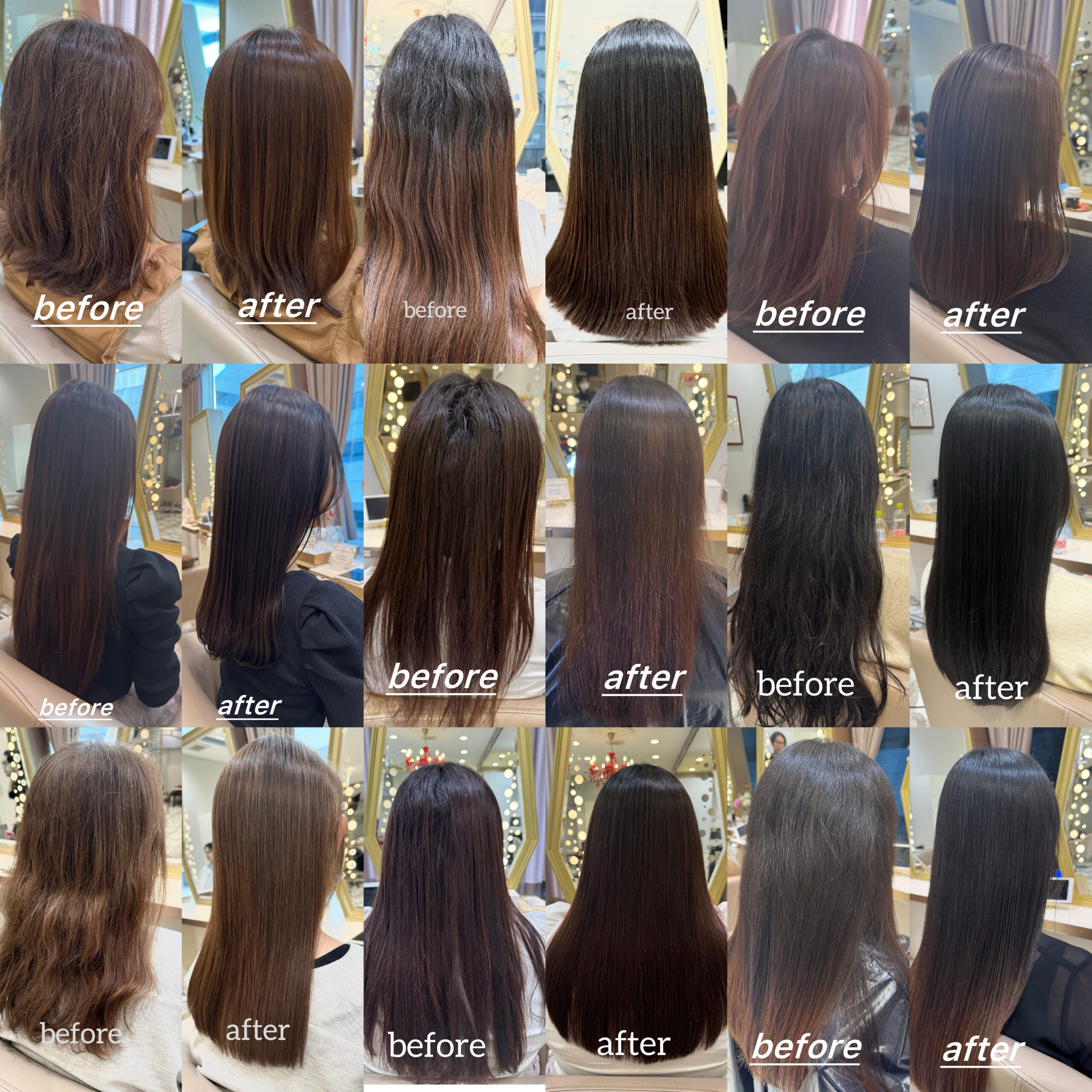
For Asian expats with thicker or more textured hair, a well-executed straightening treatment should:
✅ Feel soft and natural — not stiff, not plastic ✅ Move when you turn your head — not sit flat like a helmet ✅ Maintain condition and shine over weeks and months ✅ Not require heavy products to look good ✅ Look better on day 7 than day 1, as the treatment settles
If a previous straightening experience left your hair stiff, flat, or damaged — that’s a technique and formula problem, not an inevitable outcome of the treatment itself.
Home Country Salons vs. Japanese Salons
Many Asian expats in Japan continue to get their hair done when they visit home — because they trust their home country stylist and the communication is easier.
This is completely understandable. But it’s worth knowing:
What Japanese salons do particularly well:
- Precision cutting — the attention to detail and finishing is exceptional
- Acid straightening — Japan’s technique is among the most refined globally
- Scalp treatments — Japanese salons often have excellent scalp care options
- Consistency — the process is meticulous and repeatable
What can be harder to find in Japan:
- Stylists with experience in Southeast or South Asian hair types
- Clear English communication
- Products designed for high-porosity or very thick hair
The ideal is finding a Japanese stylist who combines the technical skill of Japanese hairdressing with genuine experience working with your specific hair type. They exist — but they’re not in every salon.
The WeChat / Line Question
Many Asian expats in Japan prefer to communicate with their stylist via WeChat or Line rather than Instagram DM or WhatsApp. If communication method matters to you, ask before you book — a stylist who works regularly with Asian expats will typically have the relevant apps.
I’m available via:
- 📱 WhatsApp: +81 80 9707 7119
- 📸 Instagram DM: @kenji_ginza_nhd
My Experience with Asian Expat Clients
I’m Kenji — a hairstylist with 25 years of experience, based in Tokyo with Yokohama: Mondays & 1st/3rd Thursdays.
I worked in Singapore for several years, where my clients included Chinese, Korean, Malaysian, Indonesian, Indian, and mixed-heritage clients on a daily basis. That experience gave me a genuine working knowledge of how differently these hair types behave — and how much the approach needs to change from one client to the next.
My sessions are one-on-one, conducted in English, and I start every appointment with a real consultation — looking at your hair, asking about your history, and explaining what I’d recommend and why.
If you’ve had inconsistent experiences at Japanese salons and aren’t sure why, send me a photo of your current hair and tell me your history. I’ll give you an honest assessment.
Book an Appointment
💬 WeChat: kenji_hairstylist
💬 WhatsApp (+81 80 9707 7119) or Instagram DM 📸 Instagram: @kenji_ginza_nhd 🕙 Yokohama sessions: Mondays, 8:30–18:30 🕙 Tokyo sessions: Tuesday–Sunday, 8:30–18:30
Send me a photo of your hair in its natural state and a description of what you’re hoping for. I’ll respond within 24 hours.
Frequently Asked Questions
I speak Japanese — do I still need an English-speaking stylist? Not necessarily. But if you want detailed discussion about your hair history, chemical options, and realistic outcomes — and you’re more comfortable having that conversation in English — then yes, it matters.
My hair is very long (waist length). Is that a problem? Not at all — but longer hair means longer processing time and often a higher price. Mention your length when you reach out so I can plan the appointment time accordingly.
I’ve been told my hair is “too damaged” for straightening. Is that always true? Not always. It depends on the degree and type of damage, and which straightening method is being considered. Send me a photo and I’ll give you an honest second opinion.
Can I combine straightening with a trim? Yes — I include a cut and finishing in all straightening appointments as standard.
How is pricing structured? Please see the Services & Pricing page for a full breakdown. I’m transparent about pricing before every appointment.
コメント