Living in Tokyo with wavy, frizz-prone hair can be a daily fight — especially through the humid months. This client, originally from the Philippines and working in Tokyo, came in with hair that expanded and lost its shape by midday. The goal: a sleek, low-maintenance bob that holds through Tokyo’s rainy season. Here is what Japanese acid straightening combined with a rounded bob cut achieved.
東京で暮らしていると、うねりや広がりのある髪は毎日の悩みになりがちです。特に梅雨の季節は大変です。今回のお客様はフィリピン出身で東京在住。午後になると髪が広がってまとまらなくなるのがお悩みでした。酸性縮毛矯正と丸みボブカットを組み合わせた仕上がりをご覧ください。
- Before & After | ビフォー・アフター
- The Concern | お悩み
- The Approach | 施術内容
- Why Japanese Acid Straightening Works for Filipino Hair | フィリピン人の髪に酸性縮毛矯正が向いている理由
- More Before & After Results | 他のBefore & After
- Why Filipino Hair Often Becomes Frizzier in Japan
- Before & After Analysis
- Things to Know Before Treatment | 施術前に知っておきたいこと
- Frequently Asked Questions
- Why Filipino Hair Often Becomes Frizzier in Japan
- Life Before and After | 施術前後の日常
- Before & After Analysis
- Things to Know Before Acid Straightening
- Frequently Asked Questions
- Send me photos before you book
Before & After | ビフォー・アフター
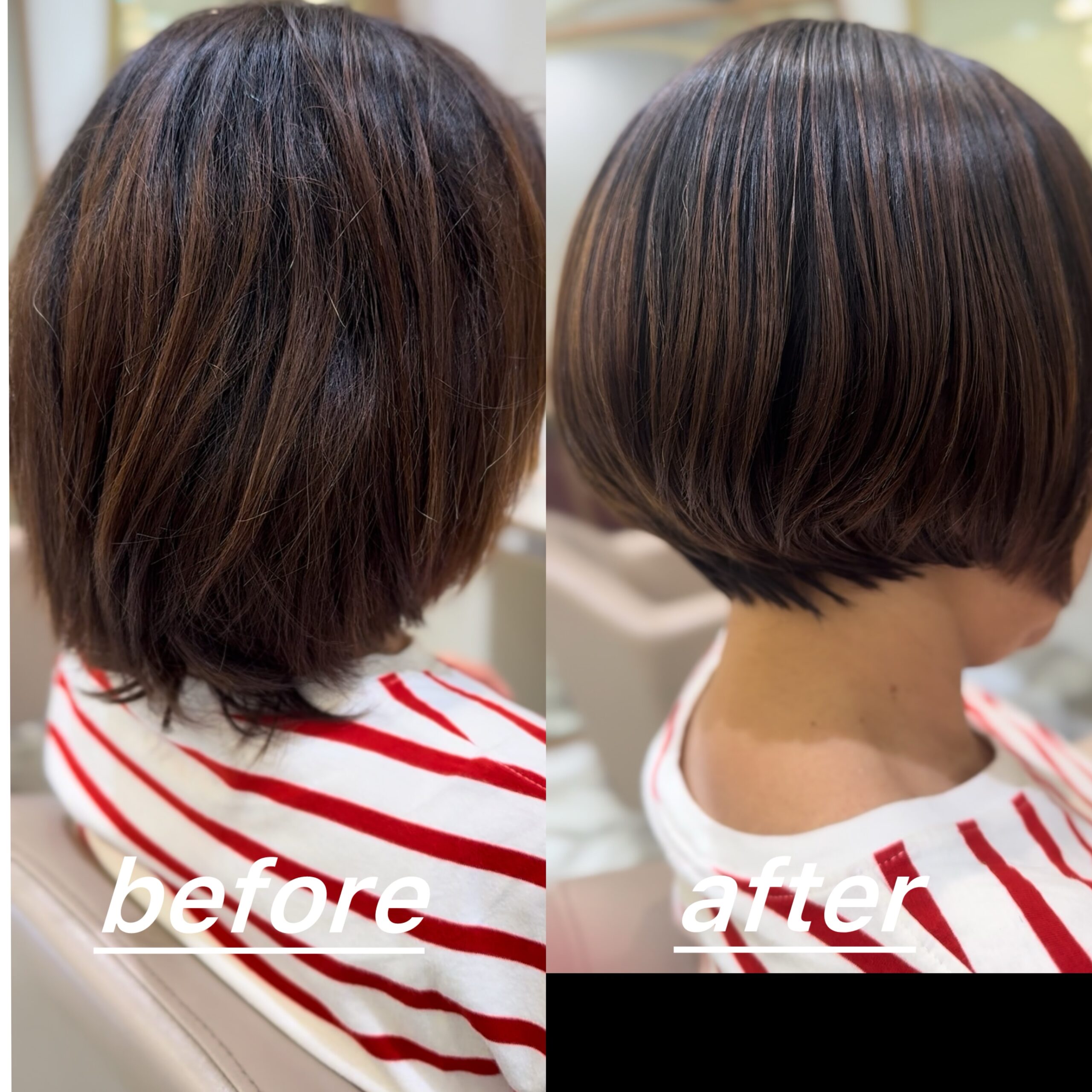
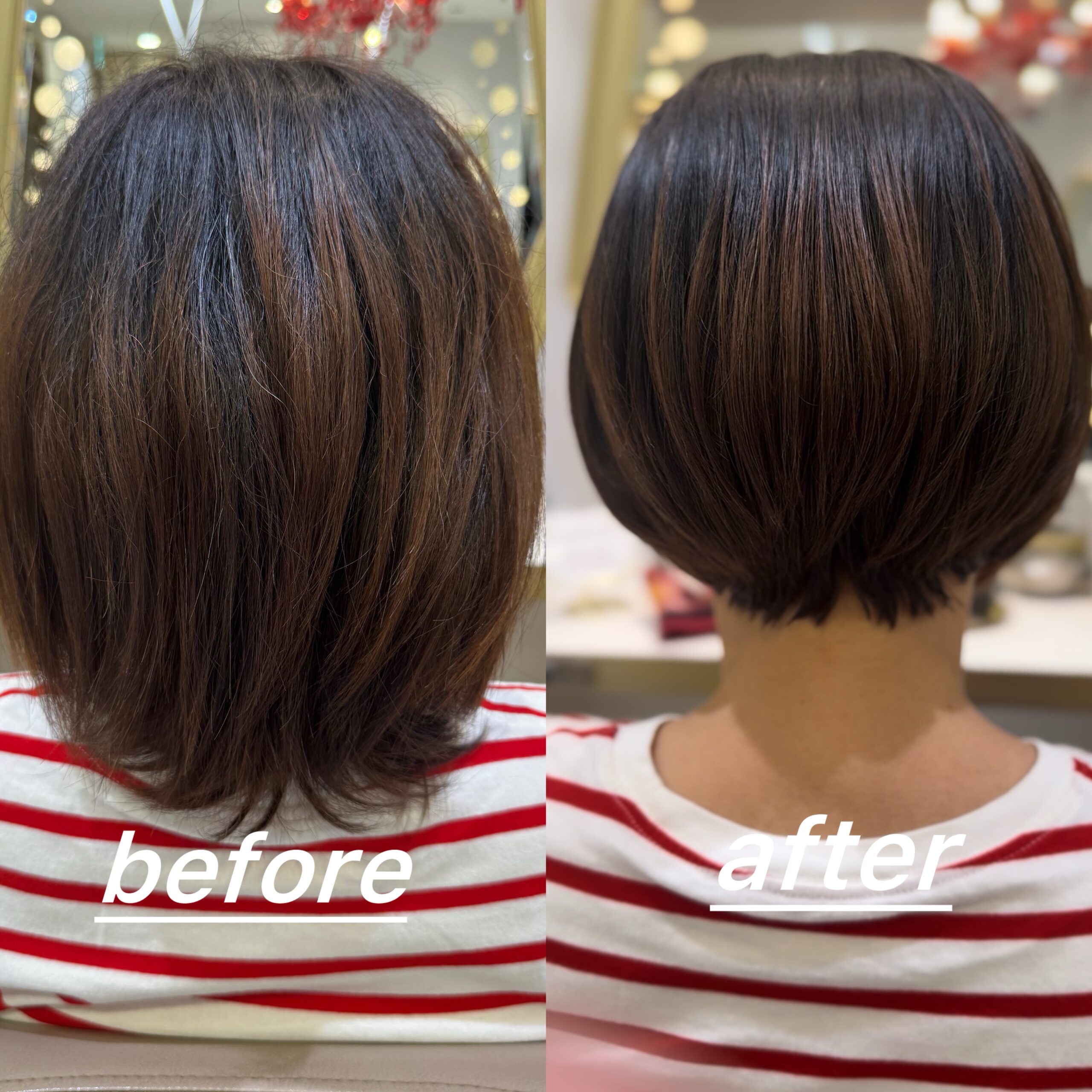
📸 Send a photo — honest assessment, no commitment
Ginza / Yokohama · English · 中文 · 23 years · One-on-one
The Concern | お悩み
Looking at the before, you can see the hair spreading outward from the mid-lengths, with visible frizz and texture irregularity. This is characteristic of wavy Southeast Asian hair in Tokyo’s humidity — the hair absorbs atmospheric moisture and the wave pattern reasserts itself, undoing any styling within hours.
ビフォーの写真を見ると、中間部から毛先にかけて外側に広がり、うねりとパサつきが目立ちます。これは東京の湿度下でよく見られる状態で、髪が水分を吸収してスタイリングが崩れてしまうパターンです。
The Approach | 施術内容
💬 KENJI — Ginza, 23 years
“For this client, we combined Japanese acid straightening with a rounded bob cut. The straightening addresses the root cause — the internal bond structure — permanently, so the hair falls smoothly after every wash without effort. The bob cut removes the weight and length that was amplifying the frizz at the ends, and the rounded shape adds softness. This combination works particularly well for Filipino and Southeast Asian hair types in Tokyo’s humid climate.”
- Treatment: Japanese acid straightening (縮毛矯正) — acid formula, pH 4–6
- Cut: Rounded bob — removes damaged ends, adds soft shape
- Hair type: Wavy, frizz-prone Southeast Asian hair
- Result: Smooth, sleek bob that holds through Tokyo’s rainy season
Why Japanese Acid Straightening Works for Filipino Hair | フィリピン人の髪に酸性縮毛矯正が向いている理由
Filipino hair typically has natural wave or curl that responds very well to Japanese acid straightening. The acid formula (pH 4–6) is significantly gentler than the alkaline rebonding (pH 9–12) common in Filipino salons, producing a softer, more natural result without the stiff feeling some clients associate with chemical straightening. Because the treated sections are permanently restructured, the result holds through Tokyo’s rainy season — no more daily fighting with frizz.
フィリピン人の方の髪質は、天然のうねりやくせを持つことが多く、日本の酸性縮毛矯正との相性は非常に良いです。フィリピンのサロンで一般的なアルカリ性のリボンディング(pH 9–12)と比べ、酸性縮毛矯正(pH 4–6)は髪への負担が少なく、より柔らかく自然な仕上がりになります。
More Before & After Results | 他のBefore & After
If you’d like to see more results from international clients at my salon: Indian Hair in Japan — Before & After → · Damaged Bleached Hair — Before & After → · Bleached Blonde Hair — Before & After → · How to Book in Tokyo (English) →
Why Filipino Hair Often Becomes Frizzier in Japan
Many Filipino clients arrive in Japan expecting their hair to behave the same way it did back home — and are surprised when it doesn’t. There are four main reasons why.
- Tokyo’s rainy season (梅雨) brings sustained humidity of 80–90% for weeks in June and July — very different from the Philippines’ tropical pattern, where heavy rain alternates with dry periods. Tokyo’s humidity is persistent and enclosed.
- Water quality — Tokyo tap water is slightly harder than Manila’s in some areas, which can affect how hair responds over time.
- Air conditioning contrast — constant cycling between humid outdoor air and dry air-conditioned interiors causes the hair to repeatedly absorb and release moisture, accelerating frizz and cuticle damage.
- UV exposure changes — Tokyo’s UV patterns differ from tropical UV, affecting colour and surface texture differently over months.
The result: hair that was manageable in Manila or Cebu becomes noticeably harder to control in Tokyo — especially from May through September.
Before & After Analysis
Before — What We Are Looking At
- Noticeable frizz — individual strands separating from the main body of hair, expanding outward particularly in the mid-lengths and ends
- Uneven texture — the surface is rough and irregular; light scatters rather than reflecting, making the hair look dull even when clean
- Volume from expansion, not density — the width is caused by moisture absorption and wave pattern, not by having more hair
- Difficult daily styling — required blow-drying and products each morning, with results that did not hold past midday in Tokyo’s humidity
After — What Has Changed
- Smoother cuticle — the hair lies flat and aligned; this is a structural change, not a product coating on top
- Improved shine — a direct result of the cuticle lying flat and reflecting light uniformly; the same hair looks visibly richer
- Natural volume — the bob sits at its actual weight and density, without the expansion caused by humidity
- Easier maintenance — after treatment, she can wash and dry her hair without products or effort and the result holds
Things to Know Before Treatment | 施術前に知っておきたいこと
- New growth will still come in wavy — the treated sections are permanently straight, but your natural root growth comes in with its original texture. Most clients return for a root touch-up every 5–8 months.
- Maintenance appointments are part of the plan — this is not a one-time fix forever. The treated length stays straight, but the roots need periodic attention.
- Colour services need careful timing — if you colour your hair, discuss the sequence with your stylist before booking. In some cases colour and straightening can be done the same day; in others it is better to separate them.
- Not every hair type or condition is suitable — heavily bleached or significantly damaged hair may need assessment first. This is why I ask for photos before every consultation.
- The first 48 hours matter — no washing, tying, or pinning for 48 hours after treatment. This is when the bonds are stabilising.
Frequently Asked Questions
How long does Japanese acid straightening last?
The treated sections are permanently straight — the result does not wash out. New root growth comes in with your natural texture, and most clients return for a touch-up every 5–8 months.
Will my hair stay straight during Tokyo’s rainy season?
Yes. Because the internal bond structure of the hair has been permanently reformed, high humidity does not reverse the result. This is the key difference from styling or surface treatments — those work from the outside and humidity undoes them. Acid straightening works from the inside.
Can I colour my hair after acid straightening?
Yes, but wait at least 2 weeks. If you want to combine colour and straightening in the same visit, discuss this during the pre-consultation — it depends on the current condition of your hair.
How is Japanese acid straightening different from rebonding in the Philippines?
Both use a reducing agent to reform the hair’s internal bonds. The main difference is pH level. Japanese acid straightening uses pH 4–6; most Philippine rebonding uses pH 9–12. The lower pH is gentler on the hair and typically produces a softer, more natural result — without the stiff feel that some clients associate with traditional rebonding.
Is it suitable for damaged or colour-treated hair?
Often yes, but it depends on the degree of damage and chemical history. Send photos with your full hair history — I will give you an honest answer before you book anything.
Living in Tokyo and struggling with frizzy hair?
I specialise in hair straightening for international clients — including Filipino, Indian, Malaysian and other Southeast Asian hair types. Every consultation is one-on-one, conducted in English.
Send me a photo on WhatsApp or Instagram DM for an honest assessment — no commitment required.
KENJI HAIR LOUNGE — GINZA & YOKOHAMA
Thinking about a change? Start with a photo.
I’ll give you an honest assessment before you commit to anything.
English · 中文 · 日本語 · One-on-one · 23 years · Singapore experience
🕙 Ginza: Tue–Sun 8:30–18:30 · Yokohama: Every Monday 8:30–18:30
⭐ Google Reviews
Why Filipino Hair Often Becomes Frizzier in Japan
Many Filipino clients are surprised to find their hair behaves very differently in Tokyo compared to Manila or Cebu. There are four main reasons. First, Tokyo’s tsuyu (梅雨) rainy season — from June through mid-July — maintains outdoor humidity at 80–90% for weeks at a time. This is not the brief tropical downpour common in the Philippines; it is sustained, relentless moisture in the air. Second, Tokyo’s water is soft water, which can make hair feel different compared to the harder water many clients are used to at home. Third, seasonal UV exposure in Tokyo’s summer weakens the cuticle, increasing porosity and making hair absorb humidity faster. Fourth, the constant cycle of air-conditioned interiors and humid exteriors stresses the hair repeatedly throughout the day. The result: hair that behaved reasonably well in the Philippines can become genuinely unmanageable in Tokyo’s summers.
Life Before and After | 施術前後の日常
Before the treatment, this client needed a blow dryer and smoothing products every single morning — and even then, her hair would lose its shape by midday in humid weather. Styling took around 30–40 minutes. After the treatment, she can wash her hair, dry it briefly, and leave the house. No products, no effort, no midday frizz. The straightening does not need to be redone — it holds permanently on the treated sections, regardless of humidity.
施術前は毎朝ドライヤーとスタイリング剤が欠かせず、30〜40分かかっていました。施術後は洗髪してサッと乾かすだけ。湿気の多い日でも午後に崩れることがありません。
Before & After Analysis
Before
- Noticeable frizz and flyaways
- Hair expanding outward at mid-lengths
- Uneven texture — wavy in some areas, not others
- Dull appearance due to open cuticle
- Difficult daily styling — 30–40 min each morning
After
- Smooth cuticle — no frizz or flyaways
- Hair falls within its natural silhouette
- Consistent texture from root to ends
- Improved shine from aligned cuticle
- Easy maintenance — wash and go
Things to Know Before Acid Straightening
I prefer to be upfront about what this treatment involves before clients book.
- New growth will still come in wavy — the treatment permanently straightens the hair that was treated, but new hair growing from the roots will have your natural texture. Most clients return for a root touch-up every 5–8 months.
- Maintenance appointments are needed — as your hair grows, you will see a line where the new wavy growth meets the straightened length. This is normal and expected.
- Colour services should be planned carefully — if you want to colour your hair, discuss timing with me before booking. Generally, I recommend a gap of at least 2 weeks between straightening and colour.
- Not every hair type is suitable — severely damaged, over-bleached, or very fragile hair may not be appropriate for treatment at a given time. This is why I always ask for photos and a chemical history before confirming a booking.
Frequently Asked Questions
How long does Japanese acid straightening last?
The treated sections are permanently straight — they do not revert or wash out. New growth comes in with your natural texture. Most clients return every 5–8 months for a root touch-up.
Will my hair stay straight during Tokyo’s rainy season?
Yes. Because the internal bond structure is permanently reformed, high humidity does not reverse the result the way it undoes a blowout or keratin treatment. This is one of the main reasons clients in Tokyo specifically choose Japanese acid straightening over other options.
Can I colour my hair after acid straightening?
Yes, but timing matters. I generally recommend waiting at least 2 weeks after straightening before any colour service. If you want to do both, mention it during your consultation and I will advise on the best order and timing for your specific hair.
How is Japanese acid straightening different from rebonding in the Philippines?
Both use a reducing agent to restructure the hair’s internal bonds — the principle is the same. The key difference is the pH level. Japanese acid straightening uses pH 4–6, while most rebonding uses alkaline formulas at pH 9–12. The lower pH is gentler on the hair structure and typically produces a softer, more natural result rather than the stiff, very flat finish some clients associate with rebonding.
Is it suitable for damaged or colour-treated hair?
Often yes, with assessment. The acid formula is gentler than alkaline alternatives and is routinely used on colour-treated hair. The actual suitability depends on the degree of damage and the hair’s current condition. Send me photos and your chemical history — I will give you an honest answer before you book anything.
Living in Tokyo and struggling with frizzy hair?
I specialise in hair straightening for international clients — including Filipino, Indian, Malaysian and other Southeast Asian hair types. Send me a photo on WhatsApp or Instagram for an honest assessment. No commitment required.
Not sure what your hair needs?
Send me photos before you book
Send me photos of your current hair and your hair history (color, bleach, or any previous straightening). I can check your hair condition before you book. No fee.
Send Your Hair Photos →Ginza: Tue–Sun · Yokohama: every Monday · One-on-one private salon · 23 years

コメント