If you are an Indian woman living in Japan, there is a good chance your hair has been giving you more trouble here than it ever did back home. The frizz returns within an hour of styling. The humidity turns everything to chaos. Products that worked in India barely make a dent in Tokyo or Yokohama. You are not imagining it — Japan’s climate genuinely behaves differently on South Asian hair, and most Japanese salons are not equipped to explain why.
I am Kenji, a hair straightening specialist with over 23 years of experience in Ginza and Yokohama. A significant part of my practice involves working with international clients from India, Southeast Asia, and Europe. This article shares what I have learned, and what the before-and-after photos below actually show.
- Why Indian Hair Becomes Difficult to Manage in Japan
- Before and After: Real Results on Indian Hair
- Is Hair Straightening in Japan Different from India?
- Benefits and Limitations: What to Expect Honestly
- Aftercare Tips
- Frequently Asked Questions
- Conclusion
- Why Indian Hair Behaves Differently in Japan
- Before & After Analysis: What the Photos Actually Show
- Frequently Asked Questions
- More Before & After Cases
- About the Stylist
- Send me photos before you book
Why Indian Hair Becomes Difficult to Manage in Japan
The Humidity Problem
Tokyo and Yokohama experience tsuyu (梅雨) — the rainy season — from roughly June through mid-July. During this period, outdoor humidity regularly sits at 80–90% for days at a time. Even outside of rainy season, the combination of heat, moisture, and sudden shifts between air-conditioned interiors and humid exteriors creates conditions that are punishing for naturally wavy or frizzy hair.
The mechanism is straightforward: hair with a natural wave or curl has disulfide bonds arranged asymmetrically in the cortex. When moisture enters the hair shaft, it temporarily disrupts the hydrogen bonds and the hair reverts toward its natural wave state. The more porous the hair — which increases with colour treatments, heat damage, or stress — the faster and more dramatically this happens. In Japan’s sustained humidity, this cycle repeats every day.
Why Styling Alone Stops Working
Blow-drying and flat irons address the surface and temporarily align the cuticle — but they do not change the internal bond structure. In India’s climate, that may be sufficient. In Tokyo in July, your style often does not last an hour. Many Indian clients I see have tried every product and technique available before concluding that something more structural needs to change.
Send a photo first — honest assessment, no commitment
Ginza / Yokohama · English · 23 years · One-on-one
Before and After: Real Results on Indian Hair
The three before-and-after photos below are from Indian clients at my Ginza and Yokohama salons. I will describe honestly what is visible — I will not add details that cannot be seen in the photos.
Case 1: Medium-Length Wavy Hair with Frizz
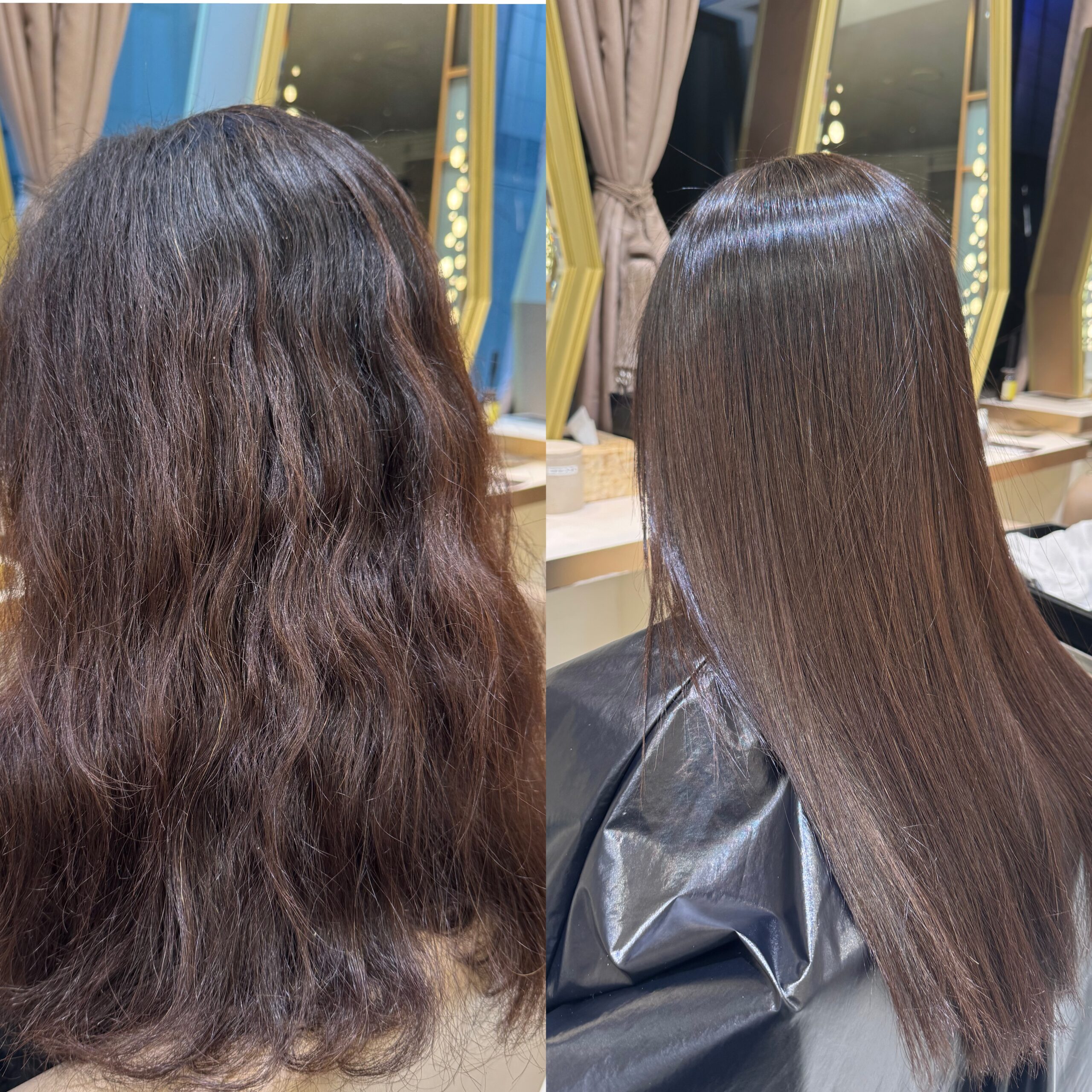
Before: Medium-length dark brown hair with a clear wave pattern, considerable volume and frizz throughout. The surface texture is uneven, with individual hairs moving in different directions. The ends show additional irregularity compared to the roots. This appears to be natural texture interacting with Japan’s humidity rather than chemical damage.
After: The hair falls cleanly from roots to ends with a smooth, aligned surface. Volume has reduced to a natural level — the result is not artificially flat but controlled. There is visible shine across the length, reflecting a closed, smooth cuticle. The ends are tidy and fall evenly.
Case 2: Long Hair with Strong Wave and High Volume
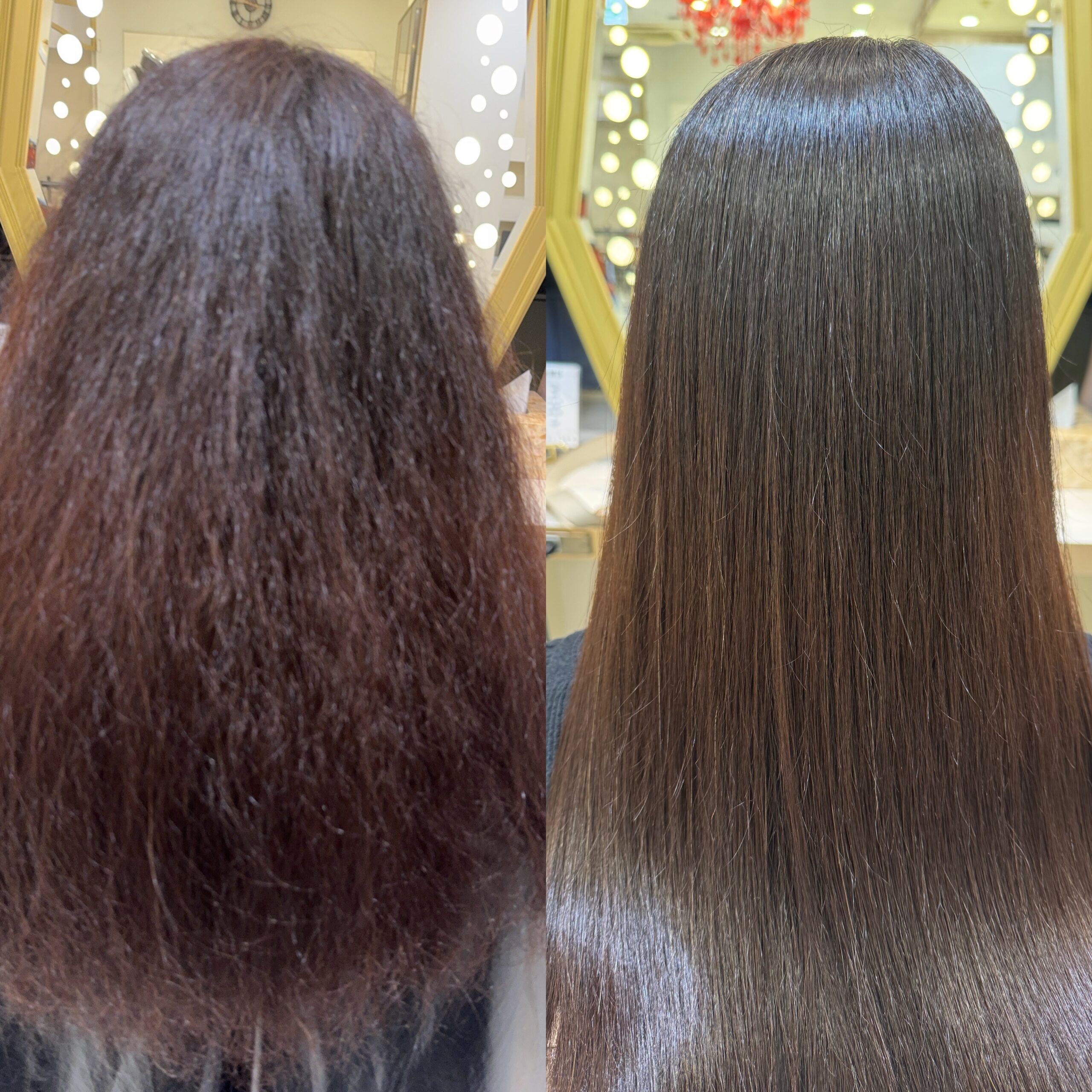
Before: Long hair with a pronounced wave pattern and high volume, particularly in the mid-lengths and ends. The texture is markedly frizzy — individual strands separate visibly from the main body of hair. The overall silhouette is wide and undefined. The colour shows a warm brown tone throughout.
After: A complete structural change is visible. The hair falls straight from roots to ends, with significant shine throughout — particularly in the mid-lengths. The colour appears deeper and more consistent, a natural effect of the cuticle lying flat and reflecting light uniformly. The silhouette is clean and contained.
Case 3: Long Hair with Irregular Wave Pattern
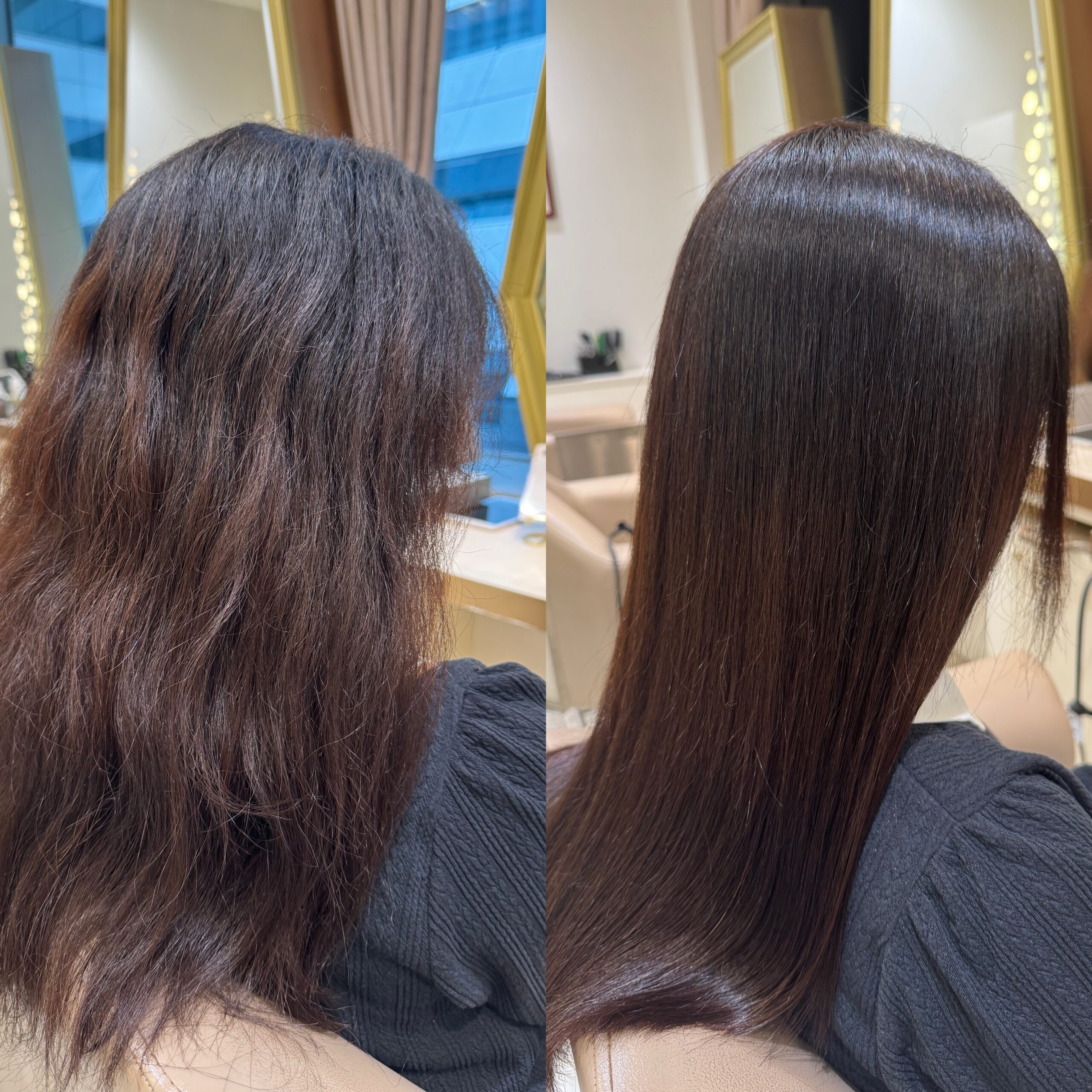
Before: Long dark hair with a wave pattern more pronounced in the mid-lengths and ends than at the root. Visible frizz and texture irregularity — the hair does not fall in a consistent pattern. The ends show spread and unevenness.
After: The hair falls with a smooth, consistent line from roots to ends. The irregular texture has resolved — mid-lengths and ends now align with the root area. Good shine is visible and the hair lies close to the back, indicating full cuticle alignment. The result looks natural rather than stiff or over-processed.
Send a photo first — honest assessment, no commitment
Ginza / Yokohama · English · 23 years
Is Hair Straightening in Japan Different from India?
Yes — in several meaningful ways.
Acid vs Alkaline Formulas
Straightening used in most Indian salons — whether called rebonding, smoothing, or permanent straightening — typically uses an alkaline formula with a higher pH (around 9–12). These formulas are effective but aggressive. They open the cuticle wide, which produces strong straightening but also more potential damage, particularly on hair with any prior chemical history.
Japanese acid straightening (縮毛矯正, shukumo kyousei) works at a significantly lower pH — typically 4–6. The reducing agent still breaks and reforms the disulfide bonds that give hair its shape, but the lower pH produces less cuticle disruption. The result, when done correctly, is a treatment that feels softer and more natural — not the slightly stiff texture that some clients associate with rebonding in India. Japan has been refining this technology for decades, driven by domestic demand for managing wave and frizz in a humid climate.
The Consultation Process
Every client in my practice goes through a photo-based pre-consultation before booking. I need to understand your chemical history — any previous rebonding, colour treatments, henna use — before selecting the right formula. Getting this wrong does not just produce a poor result; it can cause damage that takes months to grow out. The photo consultation is how I avoid that.
Benefits and Limitations: What to Expect Honestly
What Japanese Acid Straightening Can Do
- Permanently restructure the treated sections — the result on treated hair does not wash out. New growth needs a root touch-up every 5–8 months, but the length stays straight.
- Reduce daily styling time significantly — most clients go from 40–60 minutes of morning styling to 10–15 minutes or less.
- Maintain results through Tokyo’s rainy season — because the structural change is permanent, high humidity does not reverse it the way it reverses a blowdry or keratin treatment.
- Produce a natural-looking result — the acid formula and precise iron technique produce hair that moves, not hair that looks stiff or over-processed.
Honest Limitations
- It is a commitment — the treated sections are permanently straight. If you want your natural wave back, you wait for it to grow out.
- New growth requires maintenance — roots grow in with your natural texture. Most clients return for a root touch-up every 5–8 months.
- Chemical history matters — heavily bleached or repeatedly rebonded hair may need a recovery period before treatment. This is why the pre-consultation exists.
- Henna complicates things — if you have used henna, particularly metallic henna, tell me before booking. Metallic salts in some henna products can react unpredictably with chemical treatments. Pure vegetable henna is generally fine but must be disclosed.
Aftercare Tips
The First 48 Hours
Do not wash your hair for 48 hours after treatment. Do not tie, clip, or put your hair behind your ears during this period. Avoid heavy sweating or steam environments. These restrictions allow the reformed bonds to fully stabilise. Skipping this step is the most common reason clients feel their result is not as clean as expected.
Ongoing Care
- Shampoo: Use a gentle, sulphate-free shampoo. Note: switching shampoo does not affect the straightening result itself — the structural change is permanent regardless. The benefit is for scalp health and overall hair condition.
- Heat protection: If you use a blow dryer or flat iron, use a heat protectant. The straightened sections are permanent but can still be heat-damaged with repeated high-temperature styling without protection.
- Oils: Coconut oil and other hair oils are fine once the hair has stabilised after 48 hours. Heavy application in the first week can sometimes affect how the cuticle sets.
- Root touch-ups: When new growth becomes noticeable, contact me for a consultation. Only the new growth is retreated — the existing straightened sections do not need to be redone.
Frequently Asked Questions
Can Indian hair be straightened with Japanese acid straightening?
Yes. Indian hair responds well to Japanese acid straightening in most cases. The key variables are prior chemical history (especially bleach and metallic henna) and the current condition of the hair. Send a photo with your chemical history — I will tell you honestly whether your hair is suitable and what result is realistic.
Is it the same as rebonding?
Similar in principle — both use a reducing agent to break and reform the hair’s internal bonds. The main difference is pH level. Japanese acid straightening uses pH 4–6 versus pH 9–12 for most rebonding. This produces less cuticle damage and typically a softer, more natural result. The iron work technique is also different — more precise and section-by-section.
How long does it last?
The treated sections are permanently straight. New growth comes in with your natural texture. Most clients return for a root touch-up every 5–8 months depending on how quickly their hair grows.
I have used henna. Can I still get this treatment?
It depends on the type. Pure vegetable henna (without added metallic salts) is generally compatible but must be disclosed. Metallic or “black henna” containing metallic salts needs careful assessment. Always tell your stylist about henna use — this is not a trivial detail.
Do you speak English? How do I book?
Yes — consultations and appointments are in English. The process: send me photos of your hair via Instagram DM, WhatsApp, or WeChat with your chemical history. I will respond with an honest assessment and accurate price before you book anything. No commitment required to start.
Where are you located?
Ginza, Tokyo (Tuesday–Sunday, 8:30–18:30) and Yokohama (every Monday 8:30–18:30, plus Tuesday–Friday evening slots 20:00–23:30). Both are easily accessible by train.
Conclusion
If you are an Indian woman living in Japan and your hair has become genuinely difficult to manage here, you are dealing with a climate mismatch that styling alone will not solve. Japanese acid straightening addresses the root cause — the internal bond structure that makes your hair return to wave or frizz in humidity — permanently. The three cases in this article represent real clients with real Indian hair textures, not idealised results.
What matters before deciding is an honest pre-consultation: your chemical history, your current condition, and a realistic discussion of what is achievable. That is exactly what I offer. If you are curious, start with a photo.
Related: How to Book in Tokyo → · Before & After: Bleached Hair → · Tokyo Humidity Guide →
Why Indian Hair Behaves Differently in Japan
Indian hair is not a monolith. Hair texture varies significantly across India — and where you grew up shapes what your hair is used to. Japan’s climate creates a specific mismatch that is worth understanding before choosing a treatment.
Mumbai vs Tokyo: Humidity Type Matters
Mumbai’s humidity is intense but coastal — it comes in peaks, and hair adapts to a certain rhythm of wet and dry. Tokyo’s tsuyu (梅雨) season is different: it is relentless, sustained inland humidity that sits at 80–90% for weeks without relief. Mumbai hair that managed reasonably well in India often becomes completely unmanageable in a Tokyo June.
Bangalore vs Tokyo: The Cool-Climate Trap
Bangalore’s relatively mild, cooler climate means many clients from there have never truly encountered humidity-induced frizz at this scale. Their hair coped well in India because Bangalore rarely pushes the conditions that trigger maximum frizz. Arriving in Tokyo in summer is often a shock — the hair behaves in ways it simply never did at home.
Delhi vs Tokyo: Dry Heat vs Wet Heat
Delhi summers are punishing, but they are dry-heat punishing. High temperatures with low humidity actually keep the hair’s hydrogen bonds relatively stable — frizz is manageable. Tokyo inverts this: moderate temperatures paired with very high humidity means the hair absorbs moisture constantly, and the wave or frizz pattern reasserts itself within an hour of styling. For Delhi clients especially, this contrast is often unexpected.
💬 KENJI — Ginza, 23 years
“One of my Indian clients told me: ‘My hair was easy to manage in Mumbai, but became much harder after moving to Tokyo. I tried everything — serums, blow-drying, different shampoos — and nothing held past an hour in the rainy season. I wish I had known about Japanese acid straightening earlier.’ That experience is very typical. The issue is structural, not product-related.”
Before & After Analysis: What the Photos Actually Show
The three before-and-after photos in this article are real client results. Here is a detailed breakdown of what changed — not just visually, but structurally.
Before: What We Are Looking At
- Coarse surface texture — individual strands visible and separating from the main body, indicating an open or rough cuticle
- Heavy frizz — the hair shaft is absorbing atmospheric moisture and expanding; this is the wave or curl pattern asserting itself
- Excessive volume — the hair extends significantly beyond its natural fall line; this is frizz-related expansion, not natural density
- Lack of shine — an open or rough cuticle scatters light rather than reflecting it; this is why frizzy hair looks dull even when clean
- Inconsistent wave pattern — some sections more affected than others, which is characteristic of Indian hair types with mixed wave patterns across the length
After: What Has Changed Structurally
- Smoother cuticle alignment — the cuticle is now lying flat, which is what allows the light to reflect uniformly rather than scatter
- Improved light reflection — the visible shine in the after photos is a direct result of cuticle alignment, not any product applied on top
- Reduced volume to natural level — the hair is no longer expanding due to moisture absorption; it is falling at its actual weight and density
- Easier maintenance — with the internal bond structure permanently reformed, the hair returns to this state after every wash, without effort
- Colour appears deeper — a consistent visual effect when the cuticle lies flat; the same colour looks richer and more saturated
📸 Send a photo — I will tell you honestly what is achievable
Ginza / Yokohama · English · 中文 · 23 years
Frequently Asked Questions
Will Japanese hair straightening damage Indian hair?
Not inherently — but the answer depends on your hair’s current condition and chemical history. Japanese acid straightening uses a pH 4–6 formula, which is significantly gentler on the hair structure than the alkaline formulas (pH 9–12) used in most Indian salons for rebonding. The main risk factors are prior bleaching, heavy colour treatments, and the degree of previous chemical processing. This is exactly why I ask for photos and a full chemical history before every consultation — not as a formality, but because it genuinely changes what formula and approach I use.
How long does Japanese hair straightening last?
The treated sections are permanently straight — the result does not wash out or fade. What changes over time is your natural root growth: new hair comes in with your original texture, and most clients return for a root touch-up every 5–8 months. The length you treated stays straight indefinitely.
Can I colour my hair after straightening?
Yes — but the timing matters. As a general guideline, I recommend waiting at least 2 weeks after straightening before any colour treatment. If you want to do both, discuss it during the pre-consultation: in some cases it is possible to do colour and straightening on the same day in the right order, but this depends on the current condition of your hair.
How much does hair straightening cost in Tokyo?
Pricing varies by salon, hair length, and condition. The honest answer is that the price range in Tokyo is wide — from ¥15,000 to ¥60,000+ for a full treatment. The most important thing is not finding the cheapest option, but finding a stylist who has actual experience with your hair type and can give you a specific quote before you book. Send me photos and I will give you an accurate price with no commitment required.
Is Tokyo better than India for hair straightening?
For acid-based straightening specifically — yes, for most clients. Japan has been developing and refining acid straightening technology for decades. The pH range, the precision of iron technique, and the overall standard of formulation are genuinely advanced. That said, “better” is always specific to what you are trying to achieve and what your hair’s starting condition is. Some Indian clients have excellent results from Indian salons using modern formulas. The difference I consistently see is in the feel and natural quality of the result — Japanese acid straightening tends to produce hair that moves naturally rather than looking stiff or processed.
More Before & After Cases
If you would like to see more real results from international clients at my salon, the following articles may be relevant:
- Japanese Straightening on Damaged Bleached Hair — Before & After — Asian client with significant bleach history and colour-treated hair
- Japanese Straightening on Bleached Blonde Hair — Before & After — German expat client in Tokyo
- How to Book Hair Straightening in Tokyo in English — step-by-step guide to the booking process
- Keratin Treatment vs Japanese Straightening: Complete Guide for Foreigners
- Tokyo Rainy Season Hair Guide for Expats
- Malaysian Hair in Tokyo — Acid Straightening Guide
About the Stylist
I am Kenji, a hair straightening specialist based in Ginza, Tokyo and Yokohama. I have 23 years of professional experience, with a significant portion of my practice dedicated to international clients. Before establishing my current salons in Japan, I worked in Singapore — an experience that gave me direct exposure to the full range of South and Southeast Asian hair types in a humid climate. Indian, Malaysian, Singaporean, and mixed-texture hair account for a large part of my international clientele. Every consultation I conduct is one-on-one; I do not delegate client assessment or treatment to junior staff. Consultations are available in English and Chinese (中文). If you have questions about your specific hair situation, the easiest first step is to send me photos via Instagram DM, WhatsApp, or WeChat — I respond personally and honestly, with no obligation to book.
KENJI HAIR LOUNGE — GINZA & YOKOHAMA
Ready to try it? Start with a photo.
I will give you an honest assessment of what is achievable for your specific hair before you commit to anything.
English · 中文 · 日本語 · One-on-one · 23 years · Singapore experience
🕙 Ginza (Tokyo): Tue–Sun 8:30–18:30 · Yokohama: Every Monday 8:30–18:30 + evening slots Tue–Fri
Not sure what your hair needs?
Send me photos before you book
Send me photos of your current hair and your hair history (color, bleach, or any previous straightening). I can check your hair condition before you book. No fee.
Send Your Hair Photos →Ginza: Tue–Sun · Yokohama: every Monday · One-on-one private salon · 23 years

コメント